
What is bounding box annotation?
Bounding box annotation is a computer vision technique where annotators draw axis-aligned rectangular boxes around objects in images, assigning each box a class label (e.g., car, person, product). Defined by four coordinates — x_min, y_min, x_max, y_max — bounding boxes are the foundational image labeling format for deep learning and used in 90%+ of object detection and object recognition models, including YOLO, Faster R-CNN, SSD, and DETR. Each labeled image becomes part of the annotated dataset that teaches neural networks to locate and classify real-world objects. Precise BPO Solution delivers the most widely used form of data labeling services globally, powering everything from autonomous vehicles to retail shelf intelligence.
Bounding box annotation is often described as the most basic form of image annotation. In production AI, it is anything but. Every single rectangle an annotator draws becomes a ground-truth teaching signal that directly shapes what a neural network learns to "see." The difference between a box that is geometrically precise and one that is 5% too loose is the difference between a model that works reliably in the field and one that fails when it matters most — a gap that shows up directly in annotation accuracy metrics like IoU and mAP.
This guide covers everything enterprise AI teams, ML engineers, and procurement leads need to understand about bounding box labeling — from how to annotate bounding boxes correctly, to IoU quality benchmarks, to the five most common object labeling errors that silently destroy model performance, to proven enterprise-grade workflows for enterprise bounding box annotation at scale. Whether you are setting up image annotation for machine learning for the first time or auditing an existing pipeline, the principles here apply equally. For teams whose AI roadmap also involves structured data capture, our online data entry services handle the data operations side of the pipeline with the same quality rigour.
Why This Guide Exists
- Annotation quality is the #1 unacknowledged driver of computer vision project failures
- Most guides cover what bounding boxes are — this one covers what makes or breaks them in production
- Written from 17+ years of enterprise annotation operations at Precise BPO Solution since 2008
Why Bounding Box Quality Directly Determines Model Accuracy
In production computer vision systems, bounding box annotation quality is not an abstract concern — it is measurable, quantifiable, and directly correlated to model performance. Data quality at the annotation stage is the single biggest lever available to AI teams before model training begins. Based on analysis of millions of annotated objects across production deep learning training data pipelines — and 17+ years of enterprise computer vision data labeling since 2008 — the evidence is unambiguous:
IoU (Intersection over Union): The Gold Standard Quality Metric
What is IoU in bounding box annotation?
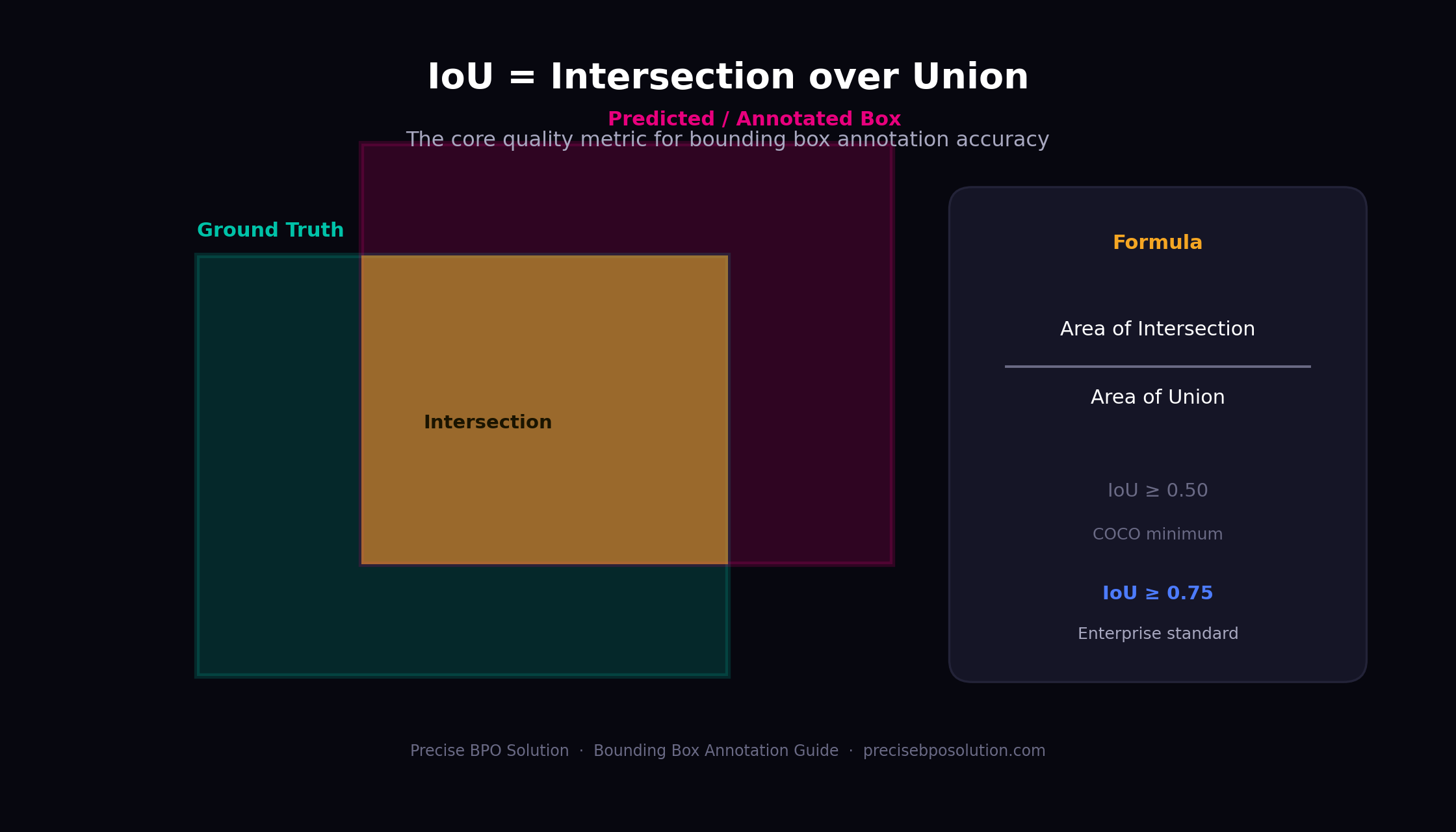
IoU (Intersection over Union) is the primary annotation quality metric for bounding box work. It measures quality by calculating the ratio of the overlapping area between the annotated box and the true object boundary to their combined area. A perfect annotation = IoU bounding box score of 1.0. An IoU threshold of 0.50 is the COCO minimum; enterprise production targets IoU ≥ 0.75. For safety-critical AI (autonomous driving, medical imaging), IoU ≥ 0.90 is the standard.
IoU is calculated as: Area of Intersection ÷ Area of Union. The resulting score from 0 to 1 is the most operationally meaningful single number among all annotation quality metrics — because it directly predicts object detection accuracy and how well the model will generalize to real-world detection tasks. Models trained on high-IoU data consistently achieve superior precision and recall, and higher mean average precision (mAP) scores across benchmark datasets.
Section Key Takeaways
- IoU is the single most important quality metric for bounding box annotation — target ≥ 0.75 for enterprise, ≥ 0.90 for safety-critical
- A 5–10% annotation error rate reduces mean average precision (mAP) by 15–30%, and increases both false positive and false negative rates — a catastrophic production impact
- Always request IoU performance data from any annotation partner before signing a contract — our primer on what data labeling involves explains the right questions to ask
Top 5 Bounding Box Annotation Mistakes That Kill Model Accuracy
In 17+ years of production image annotation bounding box work — spanning millions of labeled objects across YOLO training data, Faster R-CNN training data, and other object detection pipelines managed by the Precise BPO bounding box annotation team — these are the five object detection labeling errors that most consistently and silently destroy model performance, and how to prevent each one:
Loose Boxes — Including Too Much Background
Annotators draw boxes that extend significantly beyond the object boundary, incorporating irrelevant background pixels. The model learns to associate those background regions with the object class, causing false positives and reducing precision. This is the most common error seen across crowdsourced pipelines — a key reason why choosing the right annotation partner is a quality decision, not just a cost decision.
IMPACT: Model precision drops 8–18% in productionTight-Clipped Boxes — Cutting Off Object Edges
Boxes that clip the object — cutting off feet, bumpers, product labels — cause the model to learn incomplete object representations. In deployment, this produces missed detections at object edges and poor generalization across viewpoints.
IMPACT: Edge-feature loss, reduced recall in deploymentInconsistent Occlusion Handling
Some annotators label partially-occluded objects; others skip them. Without explicit guidelines, this creates systematic inconsistency where the model sees the same scenario labeled differently, generating noise that degrades confidence calibration.
IMPACT: Confidence score miscalibration, unpredictable recall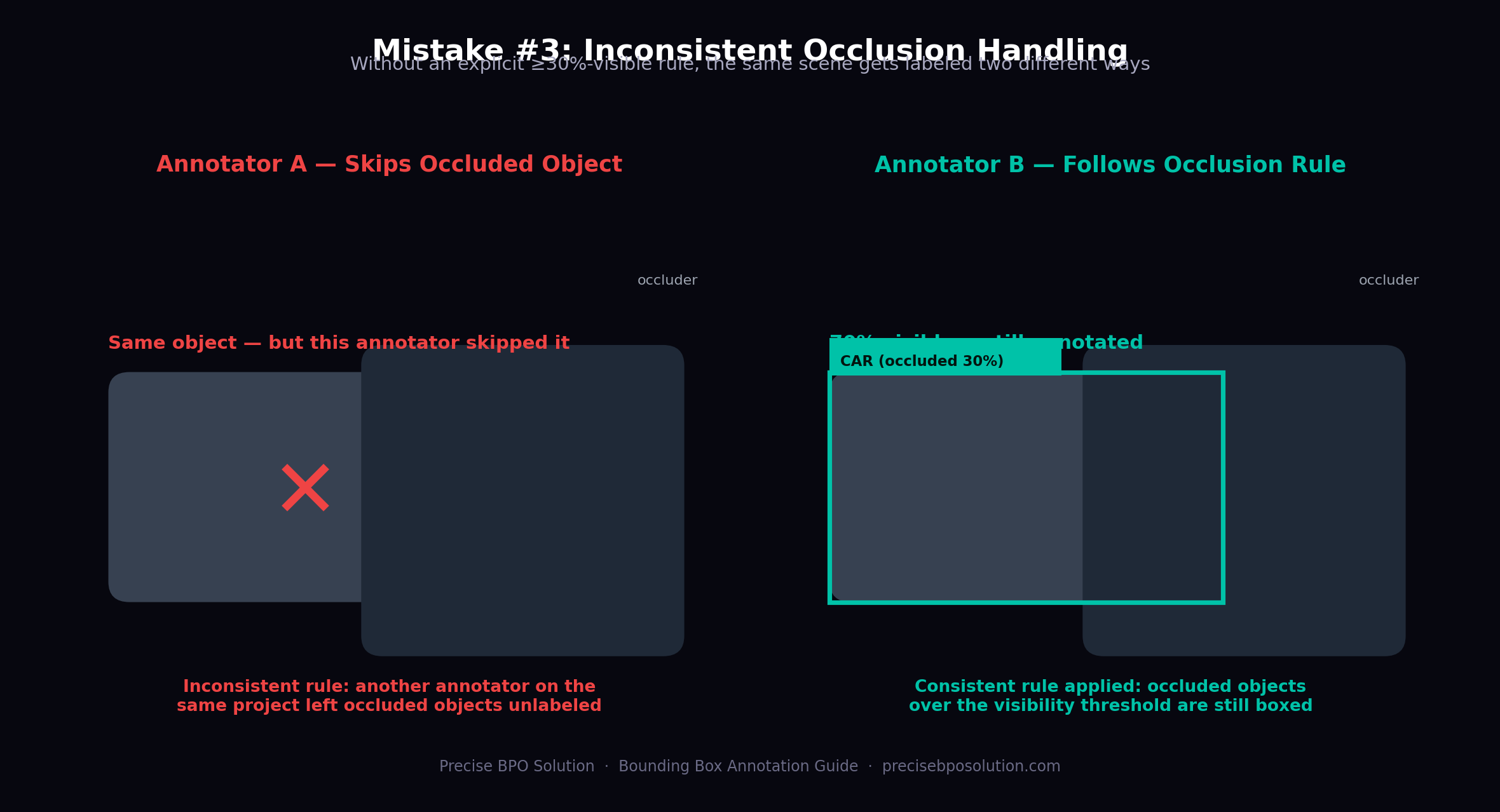
Missing Small Objects
Small, distant, or low-contrast objects are systematically missed under annotation fatigue or unclear guidelines. In traffic AI, a missed cyclist annotation means the model never learns to detect cyclists reliably. In medical imaging, a missed lesion annotation is a patient safety risk.
IMPACT: False negative rate rises 12–25% for small objectsAnnotation Drift Across a Long Project
Over a 3–6 month annotation campaign, how annotators interpret guidelines gradually shifts — boxes get looser, edge cases get handled differently, new annotators onboard with subtly different training. This creates internal dataset inconsistency that confuses the model during training.
IMPACT: Dataset inconsistency that undermines all accuracy gainsGood vs. Bad Bounding Box: What It Actually Looks Like
Box is far too loose — includes ~40% irrelevant background. Model learns background pixels as part of "person." Precision drops, false positives increase. IoU ≈ 0.58
Box tightly encloses the object — minimal background, full object included. Clean training signal. IoU against ground truth: 0.94.
Need high-accuracy object detection labeling for your AI project?
Talk to our team — free 100-image pilot, 48-hour turnaround, ISO 27001-aligned workflows.
Bounding Box Annotation in Real-World Industry Use Cases
Object detection annotation with bounding boxes powers AI systems across virtually every industry that uses computer vision. Whether you need autonomous driving annotation, medical image annotation, or retail computer vision annotation, the machine learning training data requirements, quality thresholds, and edge case frequency vary significantly by domain. Many use cases also extend to video annotation, where bounding boxes must remain consistent frame-by-frame across entire sequences — a discipline that demands dedicated annotation tools and specialist annotators:
Vehicle, pedestrian, cyclist, and traffic sign detection. Boxes must handle occlusion, motion blur, and night conditions across up to 200 objects per frame. Often paired with LiDAR annotation and 3D cuboids for full sensor-fusion training pipelines.
IoU ≥ 0.92 requiredProduct detection, planogram compliance, and inventory monitoring at the SKU level. Requires consistent labeling across thousands of product variants with minimal background inclusion.
High object densityLesion, tumor, and anatomical structure localization in X-ray, CT, and MRI scans. Safety-critical — a missed annotation directly impacts clinical decision support.
Safety-critical · IoU ≥ 0.90Crop disease, pest, and weed detection from drone and satellite imagery. Requires handling small object sizes and large variation in lighting conditions across seasons. See our agriculture annotation services for domain-specific workflows.
Small object challengePackage identification, barcode localization, and conveyor belt inspection. Requires high-throughput annotation with consistent handling of partially visible packages.
High throughputSurface defects, component misalignment, and quality control annotation on production line imagery. Tight bounding boxes critical — defects are often sub-millimeter in image space.
Sub-pixel precisionPerson, vehicle, and object tracking in CCTV footage. Night-vision annotation and long-range detection require specialist annotators with security domain experience.
Multi-frame consistencyPlayer, ball, and equipment tracking for performance analysis. Frame-level precision needed at 60fps+ with multi-object overlap across dynamic fast-motion scenes. Explore our sports video annotation capabilities.
60fps+ annotationBuilding, vehicle, and infrastructure detection from satellite and drone imagery for urban planning, disaster response, and military applications.
Multi-resolutionBounding Box vs. Polygon vs. Segmentation: Choosing the Right Method
Bounding boxes are not always the right annotation type. Here is a data-driven comparison of major annotation methods to help enterprise teams make the right decision for their specific use case:
| Annotation Type | What It Captures | Speed | Relative Cost | Primary Use Cases |
|---|---|---|---|---|
| Bounding Box ← Most Popular | Object location, size | Fastest | 1× (baseline) | Object detection, counting, tracking |
| Landmark / Keypoint | Specific point locations | Moderate | 2–3× | Pose estimation, face recognition |
| Polygon Annotation | Precise object outline | Moderate | 3–5× | Irregular shapes, instance segmentation |
| 3D Cuboid | Depth + spatial volume | Slow | 5–8× | Autonomous driving, AR/VR, robotics |
| Semantic Segmentation | Pixel-level classification | Slowest | 8–15× | Scene understanding, medical imaging |
The most successful enterprise AI teams use a progressive annotation strategy: start with bounding box labeling to validate model feasibility and ROI, then graduate to precise polygon outlining, polyline annotation for lane and road-edge detection, or pixel-level semantic segmentation for refinement once the business case is proven. For AI systems that also process unstructured text alongside images, our text annotation service integrates into the same quality-controlled pipeline.
Enterprise Challenges in Bounding Box Annotation at Scale
At scale — datasets exceeding 100,000 images or annotation teams of 20+ people — enterprise bounding box annotation becomes a complex information management discipline, not just a labeling task. Every annotation pipeline decision, from tooling to QA cadence, has measurable downstream quality consequences. Every challenge below is something our enterprise data labeling team has solved across hundreds of production projects since 2008.
The Scale Paradox
Larger annotation projects paradoxically introduce more quality risk. As datasets grow, guidelines become harder to apply consistently, new edge cases emerge, teams expand, and interpretation differences compound. Guidelines that worked for a 1,000-image pilot frequently break down at 100,000 images.
Precise BPO Approach: Pod-Based Architecture
Precise BPO operates dedicated annotation pods — self-contained teams of 10–15 annotators with a lead, quality reviewer, and domain specialist. Pod-based architecture prevents inter-team variance from contaminating datasets and enables parallel scaling without quality degradation. Serving enterprise AI teams since 2008.
Key Enterprise-Scale Challenges
- Annotation drift: Gradual interpretation shifts across a long-running project. Measured by inter-annotator agreement (IAA) scores — target IAA > 0.85 using Cohen's Kappa. When IAA drops below 0.80, quality is already compromised.
- Edge case proliferation: Real-world data constantly introduces scenarios not covered by initial guidelines — partial occlusion, unusual viewpoints, novel object combinations. Guidelines must be living documents.
- Label versioning: When class definitions change mid-project, retroactive re-labeling is expensive and often incomplete. Version-controlled annotation workflows are essential.
- Compliance documentation: Enterprise clients increasingly require full annotation audit trails for ISO 27001, HIPAA, or GDPR evidence packages. Our workflows are aligned to all three. For datasets containing sensitive personal data, our data de-identification service strips PII before annotation begins — providing a complete audit log on request.
- Human-in-the-loop annotation: Integrating annotation workflows with active learning pipelines — where models flag uncertain predictions for human review — requires structured data handoffs, consistent labeling formats, and annotation partners who understand how labeled data feeds back into retraining cycles. Many annotation vendors cannot reliably support this loop at production speed.
Hidden Cost Warning
Selecting annotation vendors on cost-per-image alone typically produces datasets requiring 30–50% relabeling before they can be used in model training. The actual cost of cheap annotation is 3–5× the apparent savings. See our data labeling pricing guide for a full cost breakdown.
Best Practices for Enterprise-Grade Bounding Box Annotation
The following six-step process is what separates a professional object detection annotation operation from a commodity labeling shop. Whether you are figuring out how to annotate bounding boxes for the first time or optimising a mature workflow, each step directly prevents the specific quality failures described above. For a broader view of where bounding box fits in the annotation decision tree, see our guide to what data labeling actually involves.
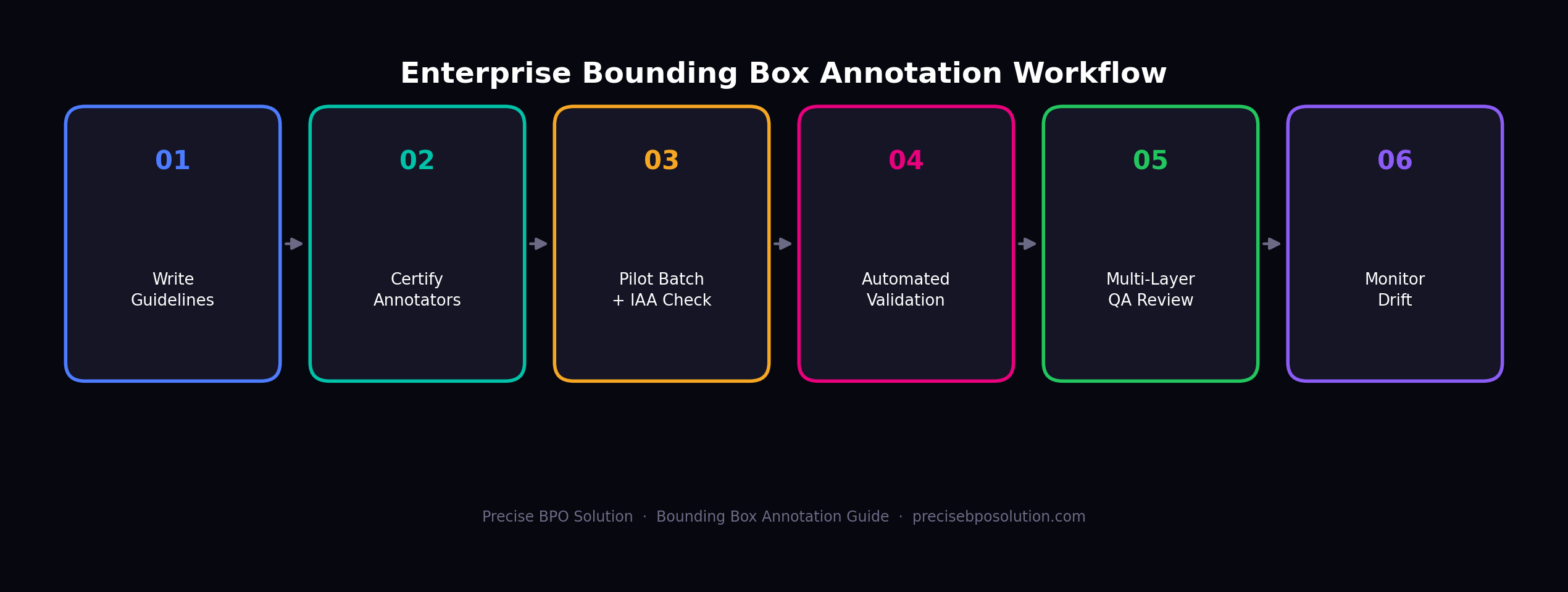
Write Unambiguous, Visual Bounding Box Annotation Guidelines
Strong object labeling guidelines are not a one-time artifact — they are a living specification. Cover: object class definitions with visual examples, minimum object size thresholds (e.g., "annotate objects ≥ 30px × 30px"), occlusion handling rules (annotate if ≥ 30% visible), truncation policies for frame-edge objects, and multi-instance overlap instructions. Every guideline decision directly determines what your labeled images teach the model about object recognition — and what they teach it to ignore. Text-only guidelines fail at scale; visual examples are mandatory.
Certify Annotators Before Production Access
Run a certification test requiring annotators to achieve IoU ≥ 0.75 and 95%+ class label accuracy on a domain-specific held-out test set before working on production data. Re-certify when guidelines change significantly or when a new domain is introduced. Precise BPO maintains a certification library of 200+ domain-specific test sets built since 2008.
Run a Pilot Batch with IAA Measurement
Annotate a 500–1,000 image pilot batch with at least three annotators labeling the same 100 images independently. Measure inter-annotator agreement using Cohen's Kappa or Fleiss' Kappa. Identify disagreement clusters and refine guidelines before scaling to production volume. This pilot is the most cost-effective investment in data quality available — it catches 80%+ of guideline ambiguities before they contaminate the full training dataset.
Implement Automated Geometric Validation
Before human review, run automated checks: IoU validation against reference samples, box dimension outlier detection, label frequency distribution monitoring, and cross-annotator consistency scoring. Automated checks catch 60–70% of errors before human review, dramatically reducing QA cost per annotation unit.
Multi-Layer Human Quality Review
Rigorous quality control annotation runs across three tiers: Tier 1 — Peer review (20% sample). Tier 2 — Senior annotator audit (5% sample). Tier 3 — Domain specialist spot-check for safety-critical categories. Each tier has defined pass/fail thresholds and escalation paths. This three-tier system is what allows Precise BPO to maintain a 99.8% bounding box annotation accuracy rate across all delivered projects.
Monitor Annotation Drift Continuously
Run weekly calibration sessions where all annotators re-label a shared reference set. Track IAA scores over time. If IAA drops below 0.80, halt production and run a full team recalibration. This prevents the gradual quality erosion that undermines long-running annotation governance. See our annotation governance guide for the full framework.
Best Practices Summary
- Visual guidelines + annotator certification prevents the majority of quality issues before annotation begins
- The pilot batch is the most underinvested step in enterprise annotation — it pays for itself 10× in avoided relabeling
- Automated validation + multi-tier human review is the only reliable path to 99.8% accuracy at scale
- Weekly IAA monitoring is non-negotiable for projects lasting more than 4 weeks
Why Enterprises Outsource Bounding Box Annotation
Building an in-house annotation capability is viable for teams with stable, predictable annotation requirements and dedicated data operations budgets. For most enterprises, the decision to outsource bounding box annotation — and broader data labeling outsourcing — to a specialist image annotation service provider delivers superior economics and quality. Even teams that invest in their own annotation tool infrastructure frequently find that the human side of the pipeline — certified annotators, QA processes, and domain expertise — is where specialist partnerships create the most value. The demand for high-quality machine learning training data has made specialist outsourcing the default choice for enterprise computer vision teams:
- Variable volume: Annotation needs fluctuate with model development cycles. Specialist outsourcing scales up or down without hiring risk or overhead. When you outsource data annotation, you pay for output, not headcount. Our retail annotation pipeline guide shows how this scales in practice.
- Domain expertise: Specialist providers maintain certified pools of domain-specific annotators — medical, automotive, retail, fashion and apparel — that in-house teams cannot cost-effectively replicate. Precise BPO has built these pools since 2008.
- Tool infrastructure: Enterprise annotation requires purpose-built tooling for annotation pipeline management, quality tracking, and audit logging. This infrastructure costs $500K–$2M+ to build in-house.
- Compliance alignment: ISO 27001-aligned, HIPAA-aligned, and GDPR-aligned annotation workflows require dedicated legal, security, and operational frameworks that most AI teams lack.
Market Data & Industry Reports: The Annotation Economy
The global data annotation market — of which object detection and image labeling represents the largest single segment — is one of the fastest-growing segments in enterprise technology services. Demand for computer vision annotation, image labeling services, and image annotation services is accelerating as AI deployment scales across industries. If you are new to the field, our guide covering what data labeling is and how it works provides essential context on where annotation fits in the AI pipeline.
The market is valued at $5.1 billion in 2026, growing at a CAGR of 26.9% according to Grand View Research. Image annotation — dominated by bounding box labeling — represents approximately 44% of total market volume.
Key External Research Sources
- Grand View Research: Data Annotation & Labeling Market Report — Market sizing, regional breakdown, competitive landscape
- Papers With Code: Object Detection Benchmarks — Current SOTA models, benchmark datasets, annotation formats
- Microsoft COCO Dataset — Gold standard benchmark for object detection, using bounding box evaluation at IoU 0.50–0.95
- Microsoft COCO: Common Objects in Context (arXiv) — Foundational paper defining bounding box annotation standards
- Gartner AI Research — Enterprise AI deployment reports and data quality studies
- Towards Open World Object Detection (arXiv) — Practitioner-relevant research on annotation quality thresholds and model performance in open-world detection scenarios
Bounding Box Annotation Benchmarks: 2026 Industry Data
The following benchmark tables are designed as a reference resource for AI teams evaluating annotation quality standards and vendor performance in 2026.
IoU Quality Standards by Application Domain
| Application Domain | Min Acceptable IoU | Enterprise Target IoU | Consequence of Failure |
|---|---|---|---|
| General Object Detection | 0.50 (COCO min) | ≥ 0.75 | Reduced mAP, higher false positive rate |
| Retail Product Detection | 0.65 | ≥ 0.80 | SKU misidentification, planogram errors |
| Autonomous Driving | 0.85 | ≥ 0.92 | Safety-critical: collision risk in deployment |
| Medical Imaging | 0.85 | ≥ 0.90 | Diagnostic errors, patient safety risk |
| Precise BPO Production Average | IoU = 0.94 across all domains | Internal QA data, 2025 | |
Annotation Pricing Tiers by Quality Level
| Tier | Price Range / Image | Typical IoU | Relabeling Rate | Best For |
|---|---|---|---|---|
| Commodity | $0.02–$0.08 | 0.60–0.75 | 30–50% | Internal prototypes, non-production tests |
| Enterprise ← Precise BPO | $0.10–$0.30 | 0.88–0.94 | <3% | Production AI, commercial deployment |
| Safety-Critical | $0.40–$1.00+ | ≥ 0.92 | <1% | Autonomous vehicles, medical AI, aerospace |
2026 Benchmark Reference — Key Numbers
- IoU 0.94 — Precise BPO production average, all projects 2025 (internal QA data)
- IoU ≥ 0.92 — Industry minimum for autonomous driving annotation and medical AI
- 15–30% mAP loss — From 5–10% annotation error rate (MIT CSAIL, 2024); affects YOLO training data and Faster RCNN training data equally
- 30–50% relabeling rate — Typical for commodity-tier computer vision training data before production use
- 3–4× ROI advantage — Quality improvements vs. volume increases beyond 50K images of object detection training data
- $13.5B — Projected global annotation market by 2030, growing at 26.9% CAGR
In Computer Vision, Precision Starts with the Box
Bounding box annotation may look simple on the surface — draw a rectangle, assign a label. In production AI, the stakes behind that rectangle are anything but simple. Every box is a ground-truth teaching signal. Every quality failure compounds across a training corpus of hundreds of thousands of images. Every shortcut in annotation methodology becomes a reliability problem in deployment.
Enterprises that succeed with computer vision treat object detection annotation as a strategic foundation — not an operational checkbox. They understand that every deep learning model is only as capable as the annotated dataset it was trained on, and that object recognition quality in the field starts with box quality during labeling. They follow bounding box annotation best practices: investing in clear guidelines, certified annotators, multi-layer quality systems, and data annotation services providers who can demonstrate consistent IoU performance at scale.
"In computer vision, precision doesn't start with the model. It starts with the box."
— Precise BPO Solution Annotation Methodology, 2026With 17+ years of production annotation experience since 2008, 540+ certified annotation experts, workflows that are ISO 27001-aligned, HIPAA-aligned & GDPR-aligned, and a production average IoU of 0.94, Precise BPO's annotation team delivers the annotation quality that enterprise AI demands. Review our bounding box annotation pricing and service details, explore the full Precise BPO data labeling services portfolio, or request your free 100-image bounding box pilot — results and IoU report delivered within 48 hours.