What Is Data Labeling? Enterprise Guide
Learn what data labeling is, its types, AI use cases, quality standards, and how enterprises scale annotation for ML.
India-based SBU, MBU & Enterprise partner delivering secure, scalable 3D cuboid annotation and LiDAR point cloud labeling for autonomous AI, robotics, and smart city projects. 99.8% accuracy. ISO 27001-Aligned, HIPAA-Aligned & GDPR-Aligned.
Enterprise-Grade Security & Data Compliance Alignment
🌍 Serving enterprises across US · UK · Canada · Australia · Europe · Middle East · APAC · LATAM
With 17+ years of experience since 2008, 540+ trained annotators, and over 810M+ images processed across annotation projects including 15M+ LiDAR point cloud and spatial labeling datasets, Precise BPO India delivers secure, scalable, and high-accuracy 3D cuboid annotation services — producing ground truth data for autonomous vehicles, robotics, smart cities, AR/VR, and AI training data pipelines.
Our SBU, MBU, and Enterprise-grade workflows ensure AI-ready datasets that accelerate model training, simulation accuracy, and actionable business insights worldwide. When you outsource 3D cuboid annotation to Precise BPO, you get enterprise-grade delivery aligned with how Precise BPO operates and safeguards client data — serving clients across US, UK, EU, Middle East, APAC, LATAM, and global markets.
As a trusted LiDAR labeling company based in Pune, India, we provide structured, multi-sensor, domain-specialized, and contextually accurate 3D datasets for LiDAR, point clouds, vehicle detection, pedestrian detection, cyclist tracking, and environmental modeling. Teams evaluating 3D annotation outsourcing India options benefit from our 17-year delivery record, NDA-first intake, and no-lock-in engagement models. 3D cuboid annotation is one of 15+ types available under our AI data labeling services portfolio — covering everything from semantic segmentation to text annotation under one SLA. Teams needing structured ground truth alongside outsourced data entry and document digitization can source both under one NDA and compliance framework — our guide to evaluating data entry outsourcing vendors covers what to look for if you're sourcing that work separately. We also support Generative AI & LLM fine-tuning for autonomous simulations, predictive analytics, robotics navigation, and smart city planning.
SBU, MBU & Enterprise spatial object labeling for autonomous vehicles, robotics, AR/VR, smart cities, and industrial AI across global markets.
Train perception models, vehicle tracking, and collision avoidance systems with precise 3D cuboid datasets for ADAS and self-driving AI. See our dedicated autonomous vehicle annotation service. Automotive clients running AV programs also rely on our vehicle data entry service for dealer, registration, and fleet records.
Improve object recognition, navigation, and warehouse automation with spatially accurate 3D point cloud datasets for robotic arms and mobile robots. Pairs well with our retail & warehouse annotation service.
Annotate traffic flows, pedestrian movement, and urban infrastructure for AI-powered traffic analysis, signal optimization, and city planning models. Aerial scene labeling also extends to our agriculture & drone annotation workflows. Municipal partners often pair this with our traffic citation data entry service for violation record processing.
Enhance immersive experiences with precise 3D spatial labeling, object orientation mapping, and scene segmentation for virtual training environments. Often combined with landmark & keypoint annotation for motion-aware simulations.
Detect and classify objects in complex, multi-layered environments for situational AI awareness, perimeter monitoring, and threat identification systems. Our de-identification service handles PII removal before annotation begins.
Annotate factory floors, robotic navigation zones, and safety-critical environments with 3D LiDAR data for predictive maintenance and collision prevention. Medical robotics teams can extend to our medical image annotation workflows.
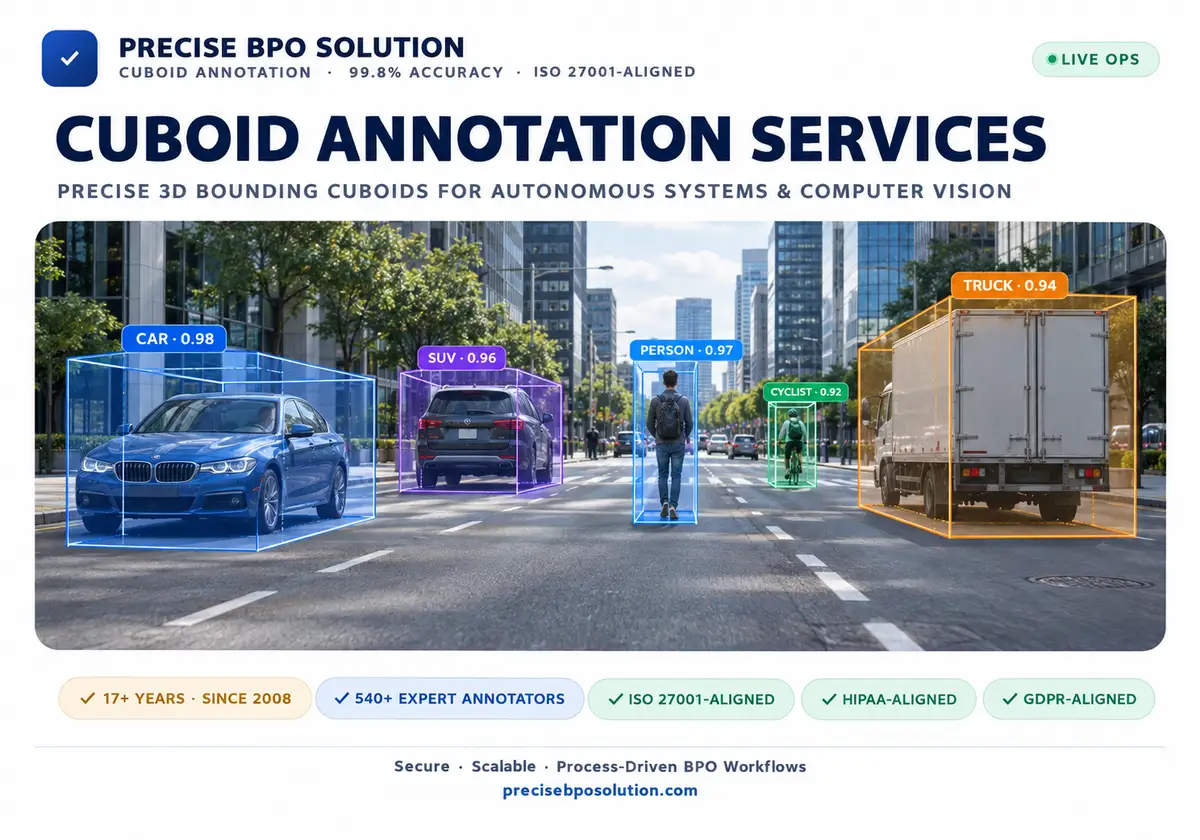
LiDAR point cloud labeling places 3D bounding boxes around objects to improve AI perception, navigation, safety, and autonomous decision-making.

Spatial object labeling in three-dimensional space using LiDAR, point clouds, and multi-sensor data enables AI models to understand object boundaries, depth estimation, motion, and spatial relationships — essential for scene understanding in autonomous vehicles, robotics, smart cities, and AR/VR simulations.
High-quality LiDAR point cloud datasets help AI detect vehicles, pedestrians, cyclists, and environmental obstacles accurately. Beyond cuboid labeling, projects often pair 3D bounding boxes with semantic segmentation, lane polyline annotation, and video labeling to build complete scene-level training datasets for autonomous vehicle perception pipelines. Advanced bounding box labeling supports multi-sensor data fusion, integrating LiDAR, radar, and camera inputs to generate comprehensive spatial maps for predictive analytics and autonomous decision-making. Whether a project calls it LiDAR data annotation, point cloud data labeling, or 3D spatial annotation, the goal is the same — giving AI models the depth and geometry context that flat 2D images can't provide on their own.
High-precision 3D cuboid labeling for LiDAR, point clouds, vehicles, pedestrians, cyclists, and environmental objects. Our cuboid annotation for object detection and 3D dataset labeling services are built for production-scale AI pipelines.

Precise cuboid placement for detecting, localizing, and continuously tracking objects across 3D frames to support autonomous perception models and navigation systems.
High-accuracy 3D bounding boxes for all road users, enabling safer ADAS and autonomous vehicle decision-making with precise spatial orientation and classification.
Frame-wise and sequence-level labeling of LiDAR point clouds, including object boundaries, occlusions, distances, and trajectory paths for spatial AI training.
Semantic and instance-level segmentation for roads, buildings, vegetation, signage, and dynamic/static scene elements for comprehensive environmental modeling.
Labeling navigation-critical cues including drivable paths, lane edges, obstacles, curb detection, and environment geometry for autonomous AI deployment.
3D cuboid placement with precise rotation vectors to support immersive AR/VR environments, spatial awareness models, and virtual training simulation platforms.
End-to-end taxonomy design, class hierarchy setup, and annotation rules tailored to your specific domain, model architecture, and project requirements.
Synchronizing and aligning LiDAR, RGB, radar, or thermal inputs to build unified multi-modal training datasets for comprehensive perception model development.
Annotation type selection directly affects model performance, dataset cost, and pipeline complexity. This comparison helps autonomous vehicle, robotics, and computer vision teams choose the right spatial labeling approach for their use case and sensor data type — whether that's depth-aware 3D bounding box annotation or simpler 2D bounding box annotation for flat-image detection.
| Criteria | 3D Cuboid Annotation | 2D Bounding Box | Polygon Annotation |
|---|---|---|---|
| Spatial Dimensions | Full 3D — X, Y, Z + orientation + depth | 2D only — no depth or orientation | 2D contour — no depth data |
| Primary Data Type | LiDAR point clouds, RGB-D, multi-sensor fusion | Camera images & video frames | Camera images, satellite, drone |
| Spatial Precision | Highest — captures true 3D geometry | Object-level only (includes background) | High — follows object contour closely |
| Annotation Complexity | High — 3D placement + rotation angles | Lowest — fastest to annotate | Moderate — multi-point polygon |
| Best For | Autonomous driving, robotics, smart cities, ADAS, warehousing | Object detection from camera, retail AI, CCTV | Irregular shapes — equipment, aerial views |
| Object Tracking | Full temporal 3D tracking across frames | 2D frame tracking — no depth continuity | Possible but very high effort |
| Output Contains | x,y,z coords, w,h,l dimensions, rotation quaternion, class, track ID | x,y,w,h coordinates + class label | Polygon vertex coords + class |
| Precise BPO Service | This page — 3D Cuboid | Bounding Box Annotation → | Polygon Annotation → |
Not sure whether your project needs 3D cuboids or 2D annotation? Request a free 3D annotation scoping call — we'll recommend the right approach based on your sensor data, model architecture, and use case. You can also read our guide to common bounding box annotation mistakes before deciding.
Platform-agnostic and format-flexible — we work within your existing 3D annotation toolchain or recommend the right stack for your LiDAR and point cloud project. Whether your team calls it point cloud data annotation, 3D data annotation, or spatial dataset labeling, we support Velodyne LiDAR annotation, KITTI format annotation, Waymo Open Dataset, and nuScenes-compatible outputs. No lock-in, no re-tooling overhead. For teams building compliance-grade annotation pipelines, our annotation governance guide covers QA frameworks and ISO 27001-Aligned audit trail practices.
End-to-end 3D workflow covering requirement analysis, dataset preparation, annotation, multi-layer QA, client review & global delivery.
Understand client objectives, SBU/MBU/Enterprise scope, object classes, sensor types, and AI goals to define clear annotation guidelines and measurable success criteria for the project.
Organize LiDAR, point cloud, and multi-sensor datasets; clean, normalize, and structure inputs to ensure consistency and optimal annotation quality before labeling begins.
Domain-trained experts apply 3D cuboids with precise positioning, orientation, and object tracking to ensure spatial accuracy across frames and temporal sequences.
Peer reviews, senior quality checks, and rule-based validation ensure consistency, 99.8% accuracy, and adherence to defined annotation standards across all object classes.
Share sample outputs, incorporate engineering feedback, and refine labeling rules to match evolving model requirements and project-specific taxonomy needs.
AI-ready datasets delivered in JSON, CSV, XML, PCD, or custom formats — with full support for batch expansion, continuous delivery, and long-term dataset scaling.
Real outcomes from AI teams across autonomous vehicles, warehouse robotics, smart cities, AR/VR simulation, industrial safety, and defense — delivered globally since 2008.
17+ years of enterprise 3D annotation excellence. Every cuboid annotation accuracy benchmark below is tracked through measurable outcomes that matter to your AI pipeline.
India-based SBU, MBU & Enterprise LiDAR labeling partner following ISO 27001-Aligned, HIPAA-Aligned & GDPR-Aligned practices for secure global AI datasets.

Global AI teams rely on Precise BPO for accurate, scalable, and compliant LiDAR labeling and point cloud annotation datasets.
Precise BPO delivered 2M+ LiDAR frames with 99.8% accuracy, ahead of schedule. Their multi-layer QA process is unmatched. Our ADAS model training improved dramatically. Highly recommended for any autonomous vehicle AI project.
We've been working with Precise BPO for 3+ years for our warehouse robotics programs. Their 3D point cloud annotation quality is exceptional and the team scales effortlessly for our peak demand cycles. Truly enterprise-grade.
The ISO 27001-Aligned, HIPAA-Aligned, and GDPR-Aligned workflows were non-negotiable for us. Precise BPO delivered on all compliance fronts while maintaining speed and accuracy. Our smart city AI deployment went live 40% faster than projected.
Every spatial annotation dataset passes three mandatory quality gates before client delivery. This multi-tier QA system catches different error types — spatial placement, orientation, class, and dimensional accuracy — so defects never compound downstream in your perception pipeline.
Human-driven first pass by the annotator, then cross-checked by a senior peer. Catches 3D placement errors, class mismatches, incorrect orientation angles, and guideline deviations before any automated scoring.
Algorithm-driven validation layer that scores every 3D cuboid against dimensional benchmarks, checks for duplicates, validates orientation consistency across frames, and flags statistical outliers across the batch.
QA Lead conducts random sampling plus full-batch review on high-stakes AV and robotics projects. Client feedback loops are built in — corrections are applied and re-verified before final sign-off.
For AI leads, ML engineers, and procurement teams justifying 3D annotation outsourcing to stakeholders — with transparent, honest numbers on cuboid and LiDAR labeling delivery. Choosing the right vendor also means evaluating their QA framework; our guide to annotation governance and label drift walks through what enterprise-grade quality control actually looks like. You can also compare top data annotation companies ranked by 3D accuracy, compliance, and scalability.
| Criteria | In-House Team | Generic BPO | Precise BPO ★ Best Value |
|---|---|---|---|
| 3D / LiDAR Annotation Expertise | ❌ Requires specialist hires — hard to find | ⚠ Limited — most lack 3D annotation depth | ✔ Dedicated 3D annotation team — LiDAR, cuboid, point cloud |
| Accuracy on 3D Spatial Data | 92–95% (inconsistent QC on 3D geometry) | 85–92% (no specialist 3D QA pipeline) | ✔ 99.8% — multi-tier 3D spatial validation |
| Setup Time | 8–12 weeks (hire 3D specialists, tooling, pipelines) | 4–6 weeks | ✔ Live in 24–48 hours |
| Scalability for LiDAR Surge Volumes | ❌ Fixed headcount — no elastic capacity | ⚠ Limited, delays common on 3D volume spikes | ✔ 540+ team, instant scale for LiDAR datasets |
| Cost vs In-House | Baseline (specialist salaries + tooling) | 25–35% savings | ✔ Up to 60% cost savings |
| ISO 27001-Aligned Security | ❌ Rarely formal for LiDAR/sensor data | ⚠ Claimed, unverified | ✔ ISO 27001-Aligned, HIPAA-Aligned & GDPR-Aligned |
| Multi-Sensor Fusion Support | ⚠ Requires separate tooling investment | ⚠ Varies — most handle LiDAR only | ✔ LiDAR + camera RGB-D + multi-sensor fusion |
| Platform Agnostic | ⚠ Limited to in-house tools | ⚠ Often platform-locked | ✔ CVAT, Scale AI Lidar, Labelbox, custom tools |
| Free Pilot / Trial | ❌ Not applicable | ❌ Rarely offered | ✔ Free pilot batch, no commitment |
Transparent 3D annotation cost — no platform fees, no lock-in. As a trusted 3D cuboid annotation company based in Pune, India, Precise BPO delivers affordable LiDAR annotation services under ISO 27001-Aligned, HIPAA-Aligned, and GDPR-Aligned workflows. Our LiDAR point cloud labeling services include a free pilot dataset before any commitment — choose the model that fits your volume, timeline, and budget. For a full cost breakdown across annotation types, read our data labeling pricing guide. If your project also requires structured data capture, our online data entry services can run in parallel under the same engagement.
Pay per labeled LiDAR frame or point cloud scan. Ideal for fixed-size datasets, one-off annotation projects, or AV teams building initial 3D cuboid annotation for autonomous vehicles at a predictable per-unit cost.
Priced per labeled 3D object. Purpose-built for high-density scenes — warehouse automation, intersection footage, urban driving datasets — where object count is the natural unit of annotation work.
Hourly model for high-complexity 3D annotation — multi-sensor fusion alignment, edge-case occlusion scenes, or long-tail object classes where per-frame pricing doesn't reflect actual annotator effort.
A dedicated 3D annotation team at fixed monthly capacity. Best for AV companies, robotics labs, and autonomous systems teams with active sensor data streams and continuous labeling needs.
Our India-based delivery hub runs 24/7 across time zones — covering US, UK, EU, APAC, Middle East, Australia, Canada, and LATAM with region-specific compliance protocols for LiDAR, point cloud, and sensor fusion datasets.
Build Accurate, Scalable 3D Datasets with Expert Cuboid Annotation
Deliver LiDAR point cloud labeling, spatial object detection datasets, and multi-sensor fusion annotation designed for real-world autonomous AI systems. Support perception, simulation, and analytics workflows with consistent, human-verified data.
Serving organizations across US · UK · EU · Middle East · APAC · LATAM
Clear answers on 3D cuboid annotation scope, LiDAR point cloud labeling, multi-sensor fusion, QA accuracy, output formats, compliance, and project scaling.
3D cuboid annotation labels objects in three-dimensional space with precise spatial bounding boxes that capture position, size, orientation, and depth. It enables AI perception models to understand real-world geometry — used in autonomous driving, robotics, smart cities, AR/VR, and warehouse automation where 2D bounding boxes aren't sufficient for spatial reasoning. It is the foundation of reliable AI training data for any project requiring 3D cuboid annotation for autonomous vehicles, drones, or industrial robots.
We annotate LiDAR point clouds, stereo camera RGB-D data, depth sensor outputs, and multi-sensor fusion inputs. These data types capture three-dimensional spatial structure and object geometry — allowing models to learn accurate distance, orientation, velocity, and motion relationships for real-world perception and navigation tasks.
Yes. Our team handles multi-sensor fusion annotation that aligns LiDAR point cloud data with camera RGB inputs to produce synchronized, spatially consistent 3D cuboid labels. This is critical for autonomous vehicle perception, ADAS systems, and robotics platforms that rely on combined sensor streams for reliable object detection and tracking.
Accuracy is enforced through a multi-layer QA pipeline: peer review, senior annotator audits, rule-based spatial validation, and batch sampling at every delivery stage. Cuboid dimensions, orientation angles, and object class assignments are verified against client guidelines. This structured review process catches spatial errors before they reach your training pipeline.
3D cuboid annotations are delivered in JSON, CSV, XML, PCD, and custom schemas compatible with your perception pipeline. Outputs include 3D bounding box coordinates, orientation quaternions, object class labels, and tracking IDs — structured for direct integration with autonomous driving frameworks, simulation tools, and ML training pipelines.
Yes. Our workflows support SBU, MBU, and enterprise-scale 3D annotation projects — including ongoing sensor data streams from autonomous vehicle fleets, robotics deployments, and simulation pipelines. Standardized guidelines, dedicated annotator teams, and batch-based delivery keep quality and consistency stable as dataset volumes grow over time.
Yes. Our annotation workflows are ISO 27001-Aligned, HIPAA-Aligned, and GDPR-Aligned to protect sensitive LiDAR, point cloud, and sensor fusion datasets. All annotators sign NDAs before project access, environments are permission-scoped, and automated security audits run continuously — ensuring your proprietary spatial data is protected end to end.
Pricing for LiDAR point cloud labeling projects is based on frame or scan volume, object density per scene, annotation complexity, and QA depth required. Models include per-frame, per-object, or monthly retainer structures. India-based delivery typically offers 50–60% cost savings versus US or UK teams. Contact us for a tailored quote based on your LiDAR or point cloud dataset scope.
Ready to accelerate your AI pipeline? Whether you want to outsource 3D cuboid annotation end-to-end or scale an existing in-house team, the Precise BPO team is available to discuss your requirements, timeline, and data scope.
Our 3D annotation experts will review your project requirements and get back to you within 24 hours. We look forward to partnering with you on your AI journey.
Practical guides on LiDAR annotation, point cloud labeling, 3D dataset quality, annotation governance, and vendor selection — for AI engineers, ML teams, and autonomous systems leads.