Bounding Box Annotation: 5 Mistakes That Destroy AI Accuracy
Bounding box annotation errors destroy AI accuracy — IoU benchmarks, 5 critical mistakes, and enterprise workflows to avoid them.
High-volume polyline annotation for roads, lanes, GIS boundaries, utilities, and mapping AI — with 17+ Years Since 2008, 540+ trained annotators, 810M+ images processed. ISO 27001-Aligned, HIPAA-Aligned & GDPR-Aligned workflows for global enterprises.
Why Global AI Teams Trust Precise BPO for Polyline Annotation
🌍 Serving enterprises across US · UK · Canada · Australia · Europe · Middle East · APAC · LATAM
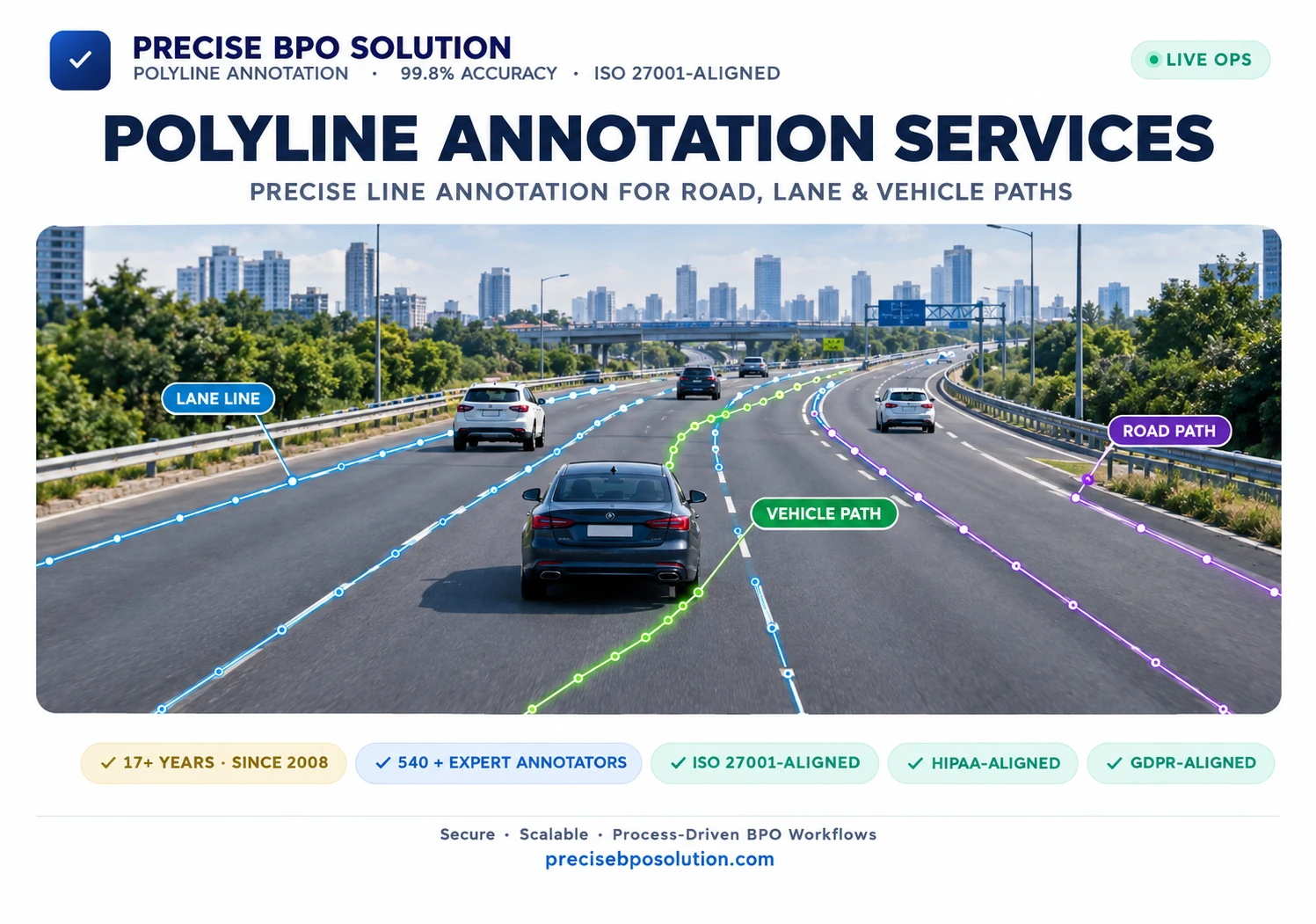
Polyline annotation is the process of tracing linear structures — lanes, roads, boundaries, cables, pipelines, and pathways — in images or video using sequences of connected points (vertices). Each polyline defines the geometric path, direction, and class of a linear feature, giving AI models the spatial ground truth needed to understand connectivity, flow, and boundary logic.
It is the primary technique used across computer vision data labeling for lane detection, GIS annotation and mapping, utility inspection, and autonomous driving. Unlike bounding boxes that enclose objects, polylines trace the exact path of linear structures in image annotation — making them essential for navigation AI, geospatial platforms, and infrastructure modeling.
Polyline annotation outputs are structured as ordered vertex coordinate lists — typically delivered as GeoJSON annotation files, Shapefile annotation exports, COCO annotation JSON, or custom schemas — delivering geometry that maps directly into GIS engines, deep learning frameworks, and path-planning systems.
Since 2008, our team at Precise BPO has delivered polyline annotation services across lane extraction for mobility AI, roofline tracing for utilities and GIS platforms, aisle mapping for retail, and route annotation for logistics — all from our Pune, India delivery centre running 24/7 across global time zones. As a trusted provider based in India, we build every dataset to your exact model specification.
Our annotators specialize in line-based geometry — applying vertex spacing standards, continuity rules, and topology checks that ensure every polyline dataset is production-ready. We handle data from dashcams, drones, satellites, CCTV, and aerial sensors — adapting to your annotation platform and output schema without switching costs.
For autonomous vehicle programs requiring high-volume lane boundary annotation for self-driving datasets, we deliver frame-accurate polyline labels at scale — covering solid lines, dashed markings, lane marking annotation, merge zones, and complex intersection geometry. Our road annotation outsourcing model lets mobility AI teams ramp from pilot to production without building in-house labeling infrastructure, reducing per-frame costs by 50–60% against US or UK equivalents. Every delivered batch is production-grade AI training data ready to feed directly into your pipeline.
Enterprises running GIS and geospatial AI projects trust us for accurate polyline labeling of utility corridors, property boundaries, and hydrological features across aerial and satellite imagery. Whether your team needs ongoing image annotation outsourcing to India for a long-term mapping programme, or a burst-capacity partner for a time-bound infrastructure survey, Precise BPO integrates directly into your existing workflow — no tool migration, no ramp-up friction, no minimum commitment. This makes us a reliable polyline annotation outsourcing partner for AI teams across 27+ countries. Teams that also need structured online data entry services or data conversion services alongside their annotation work can source all three under one NDA and compliance framework.
Polyline datasets power mapping, mobility, utilities, inspection, and retail platforms across the US, UK, and EU — enabling scalable global AI systems that rely on precise line-based geometry and spatial intelligence.
Road lane annotation, curb annotation, road-edge, barrier, and drivable-path polyline vectors for navigation AI across US, UK, EU, ME, and APAC datasets. Frame-consistent lane tracking for AV perception models and self-driving pipeline training.
Rooflines, boundaries, pipelines, utilities, river courses, and contour-based vector labeling for scalable GIS production from satellite and aerial imagery. Outputs integrate with QGIS, ArcGIS, and cloud mapping engines.
Powerline annotation, utility line annotation, and pipeline annotation from aerial and drone imagery — for predictive maintenance AI, grid management, and asset integrity systems across energy networks.
Aisle mapping, walkway flow, layout geometry, and in-store behavioral path analysis from CCTV footage — supporting retail AI systems for customer flow modeling, heatmap generation, and planogram compliance.
Road network updates, asset tracing, excavation diagrams, and project progress measurement from drone and ground-level imagery — supporting civil engineering AI and infrastructure monitoring platforms globally.
Warehouse pathways, route constraints, waypoint vectors, and yard-movement visualization for planning AI — enabling route optimization, fleet management, and last-mile delivery models with precision line-based geometry. Logistics teams tracking shipment and route records alongside these datasets often pair this with our e-BOL data entry and driver's log data entry services.
Field boundaries, irrigation lines, path mapping, and structural segmentation for agricultural and forestry AI applications — supporting precision farming, yield optimization, and land use monitoring from drone imagery.
Vessel tracing, nerve pathway annotation, and organ boundary delineation in medical imaging — enabling radiology AI, surgical navigation, and clinical decision support systems requiring precise linear structure labeling. Healthcare providers running these programs alongside back-office workflows can also use our medical claims data entry services.
Annotation type selection directly impacts model performance and labeling cost. This comparison helps computer vision and ML teams choose the right approach based on their object shape, use case, and pipeline requirements. For a deeper breakdown, see our bounding box annotation guide.
| Criteria | Polyline Annotation | Bounding Box | Semantic Segmentation |
|---|---|---|---|
| Shape | Multi-point connected line / path | Rectangle (axis-aligned or rotated) | Pixel-level mask per class |
| Best for | Linear structures — lanes, roads, cables, rivers, field boundaries | Bounded objects — vehicles, people, products, animals | Scene understanding — roads, sky, buildings, full image classification |
| Annotation Speed | Fast — path-tracing workflow | Fastest — single drag | Slowest — pixel-by-pixel |
| Cost Efficiency | High — scales well with volume | Highest — minimal effort per object | Lowest — intensive per image |
| Boundary Precision | Exact path-following precision | Object-level (includes background) | Pixel-perfect |
| Video / Temporal | Excellent — frame-by-frame path tracking | Excellent — fast frame tracking | Very high effort per frame |
| Common Use Cases | Autonomous driving, GIS mapping, utilities, agriculture, medical | Retail, ADAS, medical, sports analytics, surveillance | Urban scene parsing, surgical vision, land cover mapping |
| Precise BPO Service | This page — Polyline Annotation | Bounding Box Annotation → | Semantic Segmentation → |
Not sure which annotation type fits your project? Talk to our specialists — we'll recommend the right approach based on your feature types, model architecture, and dataset requirements.
Expert line-based annotation covering lane boundaries, GIS features, road edges, and route paths — built for high-volume, multi-class datasets that need topology accuracy across autonomous driving, mapping, and enterprise CV pipelines.

Structured workflow covering requirement understanding, data ingestion, line labeling, multi-stage QC, client review, and final delivery — optimized for 99.8% accuracy at scale.
Define annotation goals, line classes, vertex spacing rules, topology standards, continuity logic, and output schemas with your AI or GIS team before any labeling begins.
Images and video are received via encrypted transfer, normalized to standard formats, geo-referenced where required, and structured into labeled batches under NDA-bound, ISO 27001-Aligned infrastructure.
Specialized annotators trace polylines with client-defined vertex density, spacing standards, and class rules — using annotation platforms of your choice or our internal tooling. Video data is annotated frame-by-frame for temporal continuity.
Multi-stage QC covering topology verification, alignment audits, vertex sampling, and reviewer sign-off. Automated checks flag geometry issues before human review — enforcing 99.8% accuracy on every batch.
Annotated batches are submitted for client review. Feedback is incorporated via structured revision cycles — maintaining quality alignment across evolving guidelines and dataset requirements.
Outputs delivered in your required format — GeoJSON, Shapefile, COCO JSON, CSV, or custom — via secure transfer. Ongoing support for active learning pipelines, model retraining cycles, and extended annotation engagements.
Polyline labeling for lane detection, aerial mapping, utility inspection, retail layout, and infrastructure — tailored annotations making models production-ready for global AI teams.
Platform-agnostic and format-flexible — we work within your existing tools or recommend the right stack for your project. Our annotators are trained across CVAT polyline workflows, Labelbox annotation pipelines, and seven other major platforms. No lock-in, no re-tooling overhead.
Precise BPO is an India-based polyline annotation company with 17+ years of experience since 2008 — delivering accurate, scalable, and cost-efficient line labeling to AI teams worldwide. As a trusted outsourcing partner, we handle high-accuracy line labeling for autonomous driving, HD maps, GIS vector mapping, utility cable tracing, and medical contour work — all through 540+ in-house annotators. Trusted across US, UK, Canada, Australia, Europe, Middle East, APAC & LATAM.
Start Your Polyline Annotation Pilot →Deep institutional knowledge of line-based annotation workflows — from simple lane markings to complex multi-vertex GIS polylines — built over nearly two decades.
Dedicated, trained annotation teams delivering precise polyline labels at enterprise scale — no crowdsourced workers, no quality compromise on any dataset size.
Secure access control, NDA-bound workflows, and automated security monitoring ensure your sensitive map and imagery datasets stay protected end to end.
Multi-stage QC combining topology validation, vertex-precision checks, peer review, and expert audit — ensuring geometrically correct polylines on every batch.
India-based delivery at a fraction of in-house or Western BPO costs — with no hidden fees, no lock-in, and a free pilot batch before any commitment.
We annotate within your preferred tooling — CVAT, Labelbox, V7, SuperAnnotate — and deliver in GeoJSON, Shapefile, COCO, YOLO, or any client-defined schema.

Every polyline annotation passes three mandatory quality control gates before client delivery. This multi-tier QA system is how we sustain best-in-class accuracy — catching vertex placement, topology, and path continuity errors so defects never compound downstream.
High accuracy is not a default outcome — it is the result of disciplined process at every stage.
Human-driven first pass by the annotator, then cross-checked by a senior peer. Catches vertex placement errors, path discontinuities, class mismatches, and guideline deviations before any automated scoring.
Algorithm-driven layer that validates polyline geometry, checks vertex density, detects broken or overlapping paths, and flags statistical outliers across the batch for human re-review.
QA Lead conducts random sampling plus full-batch review on high-stakes projects. Client feedback loops are built in — corrections applied and re-verified before final sign-off and delivery.
For AI leads, ML engineers, and procurement teams justifying outsourcing to stakeholders — a direct, honest comparison with transparent numbers for polyline annotation projects.
| Criteria | In-House Team | Generic BPO | Precise BPO ★ Recommended |
|---|---|---|---|
| Annotation Accuracy | 85–92% (fatigue, no geometry QC) | 90–94% (inconsistent topology checks) | ✔ 99.8% — 3-tier geometry pipeline |
| Setup Time | 6–10 weeks (hire, train, tool) | 3–5 weeks | ✔ Live in 24–48 hours |
| Scalability for Surge Volumes | ❌ Fixed headcount, slow ramp | ⚠ Limited, delays common | ✔ 540+ team, instant scale |
| Cost vs In-House | Baseline (salary + infra) | 25–35% savings | ✔ Up to 60% cost savings |
| ISO 27001-Aligned Security | ❌ Rarely formal | ⚠ Claimed, unverified | ✔ ISO 27001-Aligned, HIPAA-Aligned & GDPR-Aligned |
| GIS & Geo-Referenced Output | ⚠ Limited capability | ⚠ Not specialised | ✔ GeoJSON, Shapefile, geo-referenced delivery |
| Video / Frame Polyline Tracking | ⚠ Possible but slow | ⚠ Varies by vendor | ✔ Full temporal polyline tracking |
| Free Trial / Pilot | ❌ Not applicable | ❌ Rarely offered | ✔ Free pilot batch, no commitment |
Transparent pricing — no platform fees, no lock-in. Costs are structured to fit your volume and timeline, and all engagements include a free pilot batch before commitment.
Pay per annotated image. Ideal for defined datasets, one-off polyline annotation projects, or GIS teams building initial map vector sets at a predictable per-unit cost.
Priced per video frame. Purpose-built for autonomous driving datasets, CCTV movement tracking, and dashcam lane annotation where frame count is the natural unit of work.
Hourly model for high-complexity annotation — thin powerline tracing, dense vertex requirements, multi-layer GIS features — where per-image pricing doesn't reflect actual annotation effort.
A dedicated polyline annotation team at fixed monthly capacity. Best for enterprises and AI labs with continuous labeling needs, active learning pipelines, or production GIS update workflows.
Our India-based delivery hub runs 24/7 across time zones — covering US, UK, EU, APAC, Middle East, Australia, Canada, and LATAM with region-specific annotation standards and compliance protocols.
AI, GIS, and mobility teams worldwide trust Precise BPO India for consistent, scalable, and accurate polyline annotation at enterprise scale.
"Precise BPO handles our entire lane detection annotation pipeline for ADAS training data. Consistent geometry, tight vertex placement, and the team scales instantly when we need more volume. 99.8% accuracy holds every single batch."
"We outsourced roofline and boundary annotation from 20M satellite images to Precise BPO. The GeoJSON outputs integrated directly into our GIS pipeline without a single format issue. Outstanding quality and turnaround."
"Our retail movement AI improved dramatically after switching annotation providers. Precise BPO's path tracking from CCTV footage was exactly what we needed — clean, consistent polylines with correct class tags on every frame."
"We needed powerline tracing across 5M drone images for grid maintenance AI. Precise BPO's thin-line annotation guidelines were exceptional — accurate, scalable, and delivered on schedule with full GDPR-Aligned data handling."
"Exceptional white-label polyline annotation partner. They operate seamlessly on our platform, meet SLAs consistently, and the accuracy is the best we've seen from any outsourced annotation provider across 4 years of working together."
"Precise BPO India is our long-term partner for HD map polyline updates. Their cost efficiency vs in-house US teams, ISO 27001-Aligned security, and consistent 99.8% accuracy make them indispensable to our mapping pipeline."
Clear answers on scope, accuracy controls, format outputs, video tracking, large-scale project management, security compliance, and pricing.
Polyline annotation is used to label linear structures such as roads, lanes, boundaries, paths, and utilities in images or video. These annotations help AI models understand direction, continuity, and spatial relationships. They are essential for mapping, navigation, infrastructure analysis, and layout interpretation where precise line-based geometry is required. See our guide to data labeling for broader context.
Polyline annotation is applied to aerial imagery, satellite images, drone footage, dashcam video, CCTV data, and scanned maps. These datasets contain linear features like lanes, edges, borders, or paths. Annotating such data helps models learn spatial structure, movement paths, and connectivity patterns used in mapping, mobility, and infrastructure-related AI systems. Teams that also need structured data alongside annotation work can explore our data entry outsourcing guide.
Polyline annotation enables models to learn continuous paths, boundaries, and directional flow within environments. By labeling lanes, road edges, or routes, AI systems can interpret connectivity and movement constraints. This improves routing accuracy, path planning, map generation, and navigation logic in autonomous driving, GIS platforms, and mobility analytics.
Large polyline datasets are handled through standardized labeling rules, batch-based workflows, and structured review cycles. Work is divided into manageable segments while maintaining consistent geometry and class definitions. This allows teams to scale volume, update datasets incrementally, and support long-term model training without annotation drift or inconsistency.
Polyline annotation is widely used in autonomous driving, digital mapping, utilities, infrastructure monitoring, logistics, agriculture, and retail layout analysis. These industries rely on line-based data to represent paths, boundaries, and movement patterns. Accurate polyline datasets help improve spatial understanding, operational planning, and model performance globally. If you're evaluating providers, our data entry and annotation company comparison guide covers what to look for when shortlisting partners.
Consistency is maintained using predefined annotation guidelines, vertex rules, spacing standards, and class definitions. Reviewers verify alignment, continuity, and topology across samples. Multi-level review ensures similar structures are labeled uniformly across batches. See our annotation governance framework for how we enforce these standards on every project.
Polyline annotations are typically delivered in GeoJSON, Shapefile, CSV, COCO-style JSON, or custom schemas. These formats integrate with GIS tools, mapping engines, and ML pipelines — compatible with QGIS, ArcGIS, PyTorch, and TensorFlow. Structured outputs allow teams to validate geometry and use datasets directly for training or analysis.
Pricing depends on data volume, line complexity, vertex density, frame continuity, and review depth. Common models include per-image, per-frame, hourly, or monthly retainer. Our India-based delivery typically offers 50–60% savings versus US or UK providers. See our data labeling pricing guide or request a tailored quote.
Yes. Our workflows are ISO 27001-Aligned, HIPAA-Aligned, and GDPR-Aligned to ensure maximum data security for global AI and GIS partners. All annotators sign NDAs before any project access, roles are permission-scoped, and automated security audits run continuously across all project environments — protecting sensitive training datasets end to end.
Practical guides on line-based annotation, lane detection pipelines, GIS data labeling, and annotation vendor selection — for AI engineers, ML teams, and geospatial data leads.
Work with experienced India-based teams delivering accurate polyline annotation for lane detection, GIS mapping, utilities, and infrastructure AI — supported by 540+ trained annotators. Outsourcing to us typically saves 50–60% versus in-house US or UK teams without compromising quality. Our full data labeling services are available under one engagement. Meet the Precise BPO team or request a free pilot or project quote below.
Get a response within 24 hours — no commitment required.
Our polyline annotation experts will review your requirements and respond within 24 hours. We look forward to powering your AI mapping and vision datasets.