Bounding Box Annotation: 5 Mistakes That Destroy AI Accuracy
Bounding box annotation errors destroy AI accuracy — IoU benchmarks, 5 critical mistakes, and enterprise workflows to avoid them.
High-volume image annotation and bounding box labeling with 17+ years since 2008, 540+ trained annotators, and 810M+ images processed — ISO 27001-Aligned, HIPAA-Aligned & GDPR-Aligned workflows for global AI & machine learning enterprises.
Enterprise-Grade Security & Data Compliance Alignment
🌍 Serving enterprises across US · UK · Canada · Australia · Europe · Middle East · APAC · LATAM
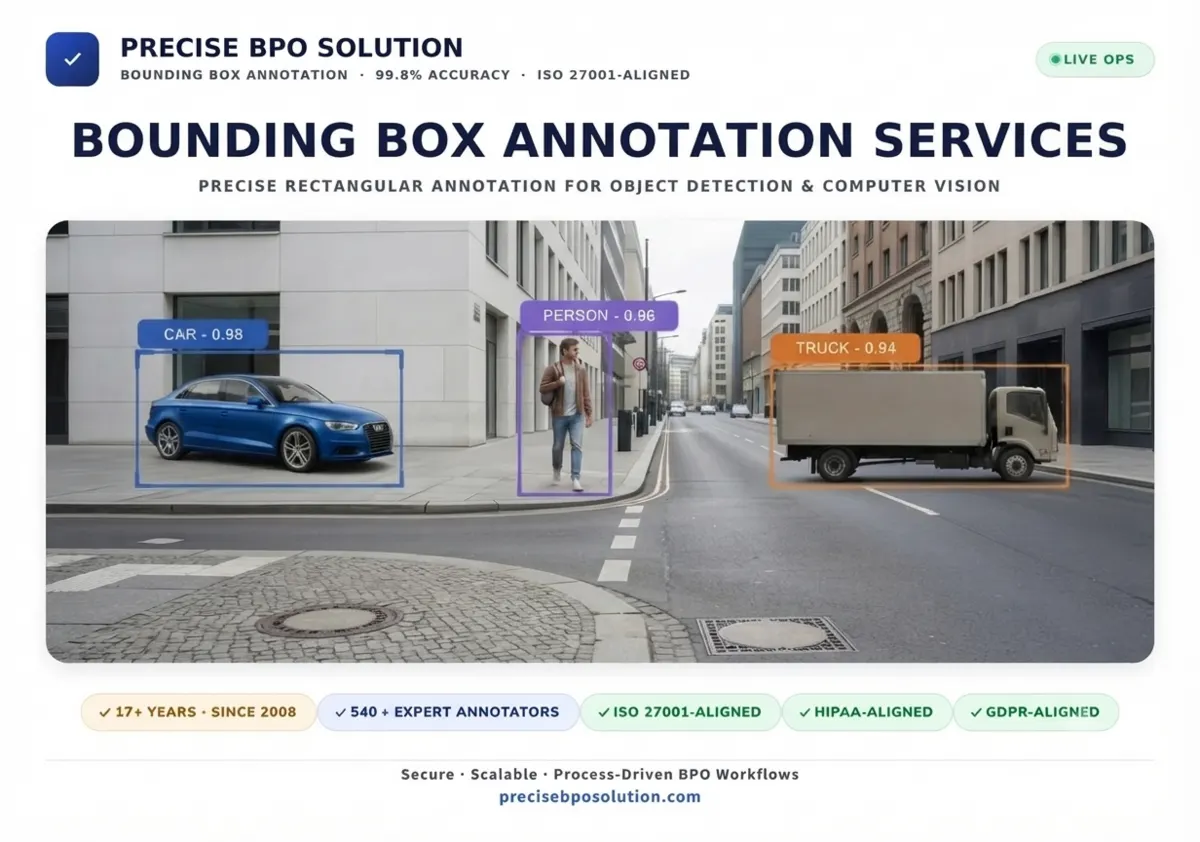
Bounding box annotation is the process of drawing rectangular frames — called bounding boxes — around objects in images or video frames. Each box defines the position, size, and class label of a specific object, providing a model with the ground truth it needs to learn where objects are and what they are.
It is the most widely used technique in computer vision data labeling because it is fast to produce at scale, compatible with every major detection framework (YOLO, Faster R-CNN, SSD, DETR), and delivers a strong accuracy-to-cost ratio for object detection, localization, and tracking tasks — making it a foundational machine learning data labeling technique for production AI systems.
A bounding box is defined by four values — typically xmin, ymin, xmax, ymax (Pascal VOC format) or center x, center y, width, height (YOLO format) — plus a class label. For 3D scenes, cuboid annotation extends this into six degrees of freedom. New to this space? Our guide to what data labeling is covers the broader context.
This annotation type is part of Precise BPO's full data labeling services portfolio — providing precise object-level labeling for detection, tracking, and localization tasks across images and video frames — making it the most widely used image annotation technique for object detection AI. Precisely drawn boxes define object boundaries, improve detection accuracy, support multi-class classification, and enhance AI model performance in complex computer vision pipelines.
Precise BPO combines 17+ years of experience since 2008 with 540+ expert annotators to deliver professional box-level object annotation, object detection datasets, and AI training data labeling services for global teams. Enterprises across the US, UK, Australia, and Europe outsource this labeling work to our AI data labeling services team for reliable, scalable delivery. Our workflows cover SBU, MBU, and enterprise projects — including class hierarchy setup, annotation guidelines, placement rules, IoU standards, and frame-level annotation quality checks. New to the space? Our data labeling fundamentals guide walks through the basics.
We have processed 810M+ images across various projects, including 390M+ object-level labeling tasks across autonomous vehicle annotation, medical image annotation, retail object detection, precision agriculture AI, geospatial, sports analytics annotation, robotics, and industrial AI domains. High-quality labeled training data and precise bounding boxes reduce false positives, improve recall, and accelerate deep learning model deployment — with high-volume annotation capacity, scalable pipelines, and large-scale dataset management built in. The Precise BPO team also supports online data entry and structured data processing for clients who need ground truth data alongside visual annotations, and data conversion services for teams migrating between annotation formats or transforming legacy datasets.


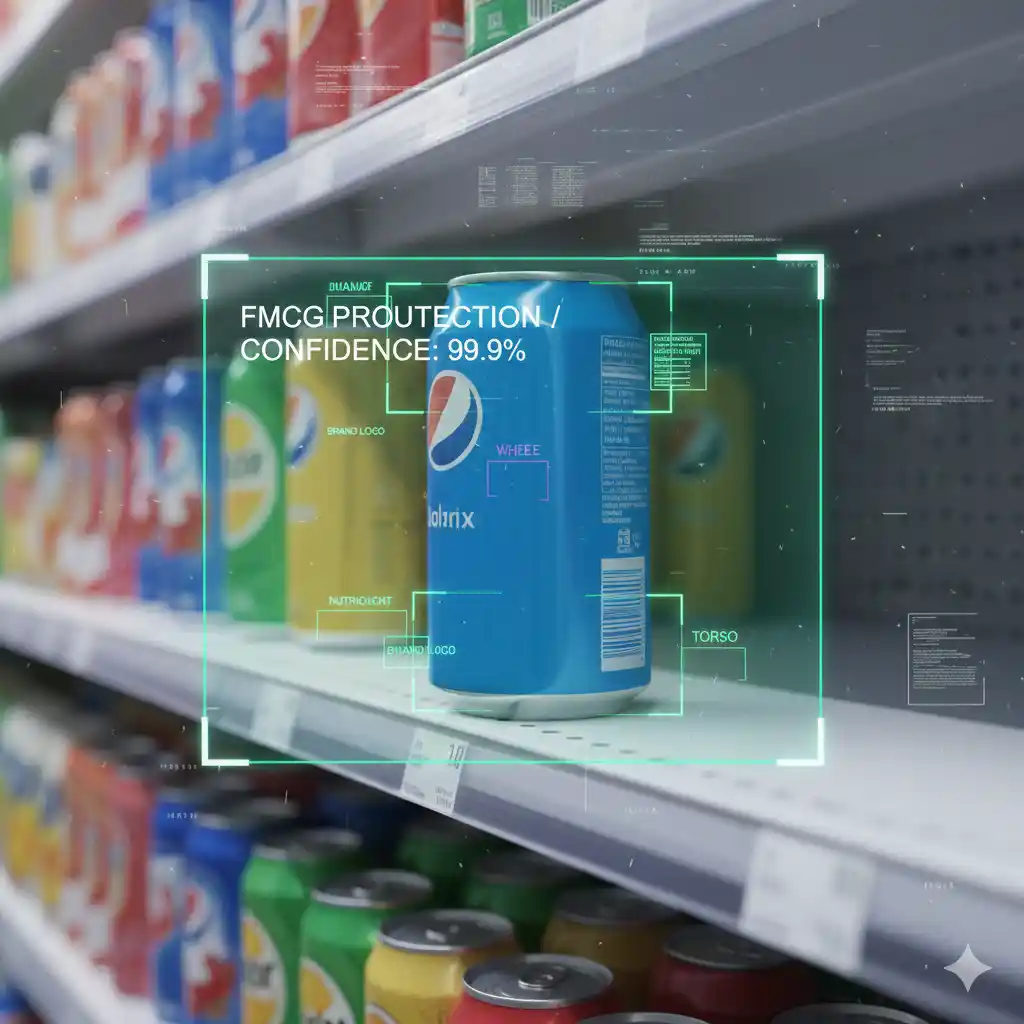
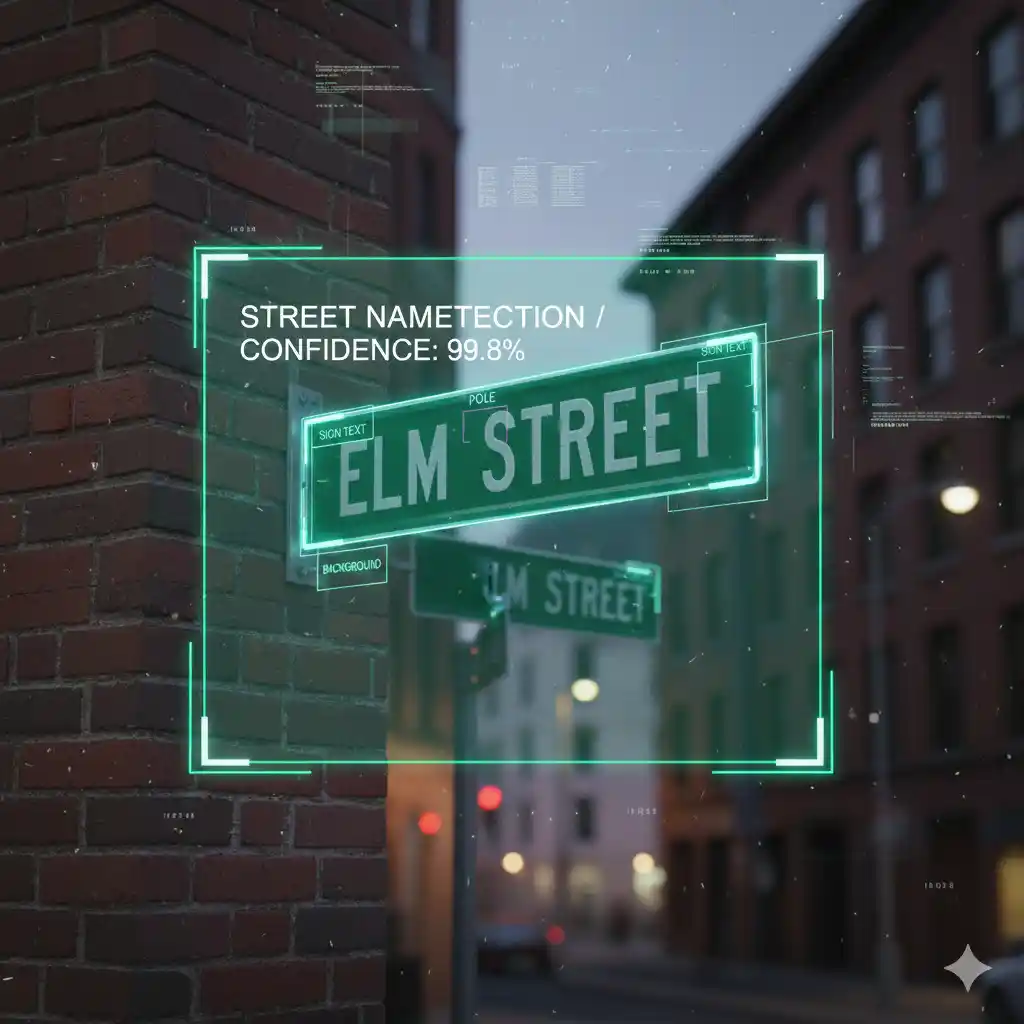
Bounding box labeling — a core image annotation bounding box technique — supports accurate object detection, localization, and object tracking — including video object tracking annotation — across computer vision systems used in diverse industry applications, from autonomous driving to marine monitoring. For retail-specific annotation best practices, see our retail data annotation workflows guide. Browse our full data labeling services to see the complete scope of annotation types we support across these industries.
Vehicle and pedestrian detection annotation for lanes, signage, obstacles, and road objects — precisely labeled to enhance navigation, perception, and localization in autonomous driving and ADAS computer vision pipelines. Automotive AI programs often pair this with our vehicle data entry services for fleet, VIN, and registration records.
Object detection labeling for medical imaging — lesions, abnormalities, instruments, organs, and clinical objects precisely labeled for diagnostic detection, surgical planning, and radiology AI models.
Retail object labeling — products, shelves, packaging, and barcodes precisely annotated for inventory automation, AR-based price-tag detection, product recognition AI, and retail analytics. Enables accurate shelf-level detection and planogram compliance at scale. Retail teams building catalog datasets often add our product data entry services to keep SKU and listing data in sync.
Crops, fruits, pests, trees, livestock, and field objects boxed from drone and satellite imagery to optimize yield and support precision farming AI.
Buildings, vehicles, rooftops, road objects, and terrain features boxed for GIS platforms, aerial mapping, and satellite-based land analysis projects.
Parts, tools, defects, components, equipment, and machinery boxed for robotic guidance, QC automation, and industrial assembly vision systems.
Objects, surfaces, furniture, tools, and moving elements boxed to enhance spatial understanding, calibration, and immersive 3D AI environments.
Fish, marine animals, debris, nets, and underwater objects boxed from ROV/AUV footage to support aquaculture, species detection, and ocean monitoring AI.
Players, equipment, ball trajectories, and field zones boxed for performance analytics, broadcast AI, and real-time tracking applications.
Annotation type selection directly impacts model performance and labeling cost. This comparison helps computer vision and ML teams choose the right approach for their detection task and dataset.
| Criteria | Bounding Box | Polygon Annotation | Semantic Segmentation |
|---|---|---|---|
| Shape | Rectangle (axis-aligned or rotated) | Custom multi-point polygon | Pixel-level mask per class |
| Best for | Objects with regular shapes — vehicles, people, products, animals | Irregular shapes — aircraft, equipment parts, biological specimens | Scene understanding — roads, sky, buildings, full image classification |
| Annotation Speed | Fastest | Moderate | Slowest |
| Cost Efficiency | Highest | Medium | Lowest |
| Boundary Precision | Object-level (includes background) | High — follows object contour closely | Pixel-perfect |
| Video / Temporal | Excellent — frame tracking | Possible, high effort | Very high effort per frame |
| Common Use Cases | Autonomous driving, retail, medical, agriculture, ADAS | Drones, satellite, fashion, industrial parts | Urban scene parsing, surgical vision, land cover mapping |
| Precise BPO Service | This page — Bounding Box | Polygon Annotation → | Semantic Segmentation → |
Not sure which annotation type fits your project? Get a bounding box vs. segmentation recommendation — we'll suggest the right approach based on your object classes, model architecture, and dataset volume.
Expert bounding box labeling and bounding box image annotation service — including 2D, rotated, and oriented bounding box formats — supporting multi-class, high-precision, and occlusion-aware object detection across complex computer vision workflows and enterprise AI pipelines.
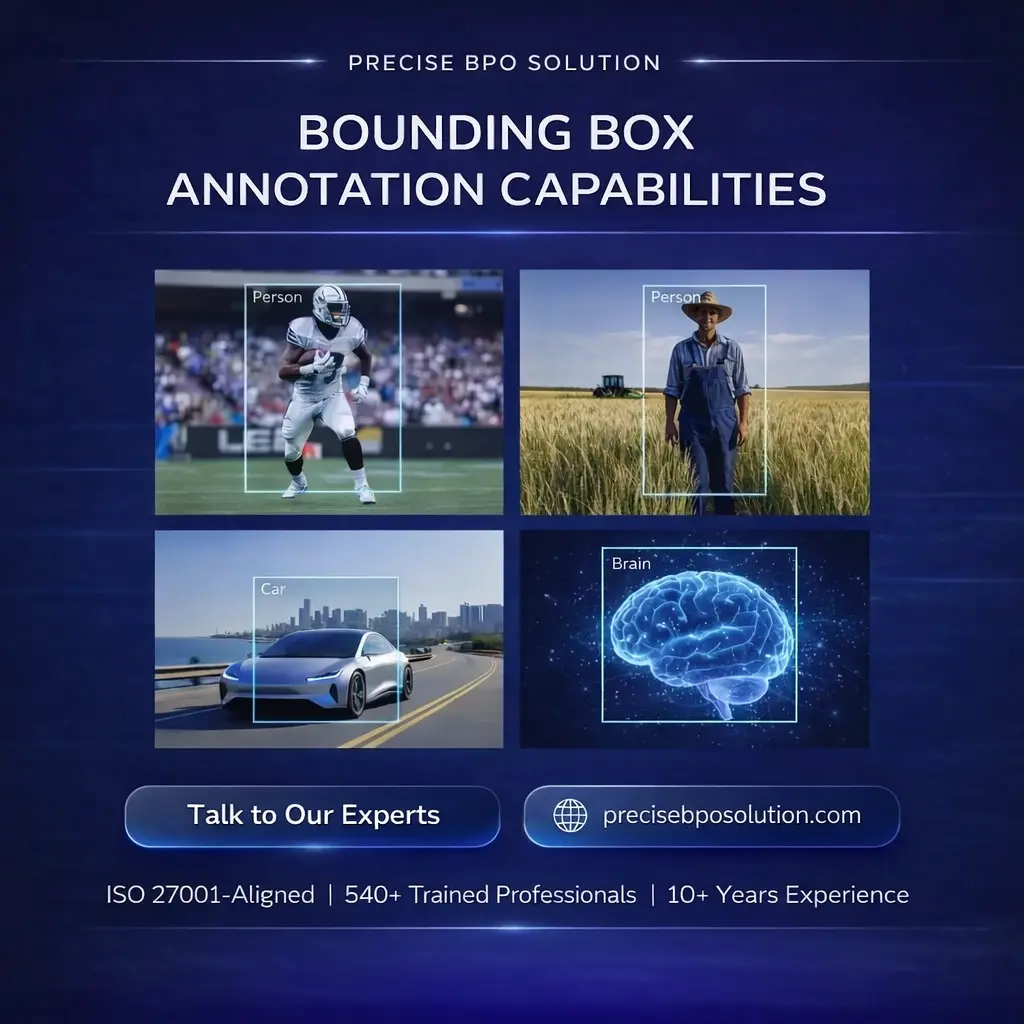
Platform-agnostic and format-flexible — we work within your existing toolchain or recommend the right stack for your project. No lock-in, no re-tooling overhead.
End-to-end workflow covering project setup, frame-level object labeling, multi-stage quality checks, review steps, and final delivery — optimized for speed and 99.8% accuracy. Our guide to annotation governance defines how each step is standardized and audited across every client project.
Define detection goals, object classes, annotation rules, IoU thresholds, and box placement standards with your AI team before any labeling begins.
Images and videos are received via encrypted transfer, normalized to standard formats, and structured into labeled batches under NDA-bound, ISO 27001-Aligned infrastructure.
540+ trained annotators draw precise box-level labels per object class, ensuring correct IoU alignment, box tightness, and temporal annotation consistency across video bounding box and static image datasets.
IoU validation, box consistency audits, automated QC sampling, and expert reviewer sign-off maintain a consistent 99.8% annotation accuracy benchmark across all batches.
Integrate feedback, refine box rules, update class lists, and adjust sampling or detection standards — iterating until the dataset fully meets your pipeline requirements.
Deliver bounding box datasets in COCO JSON, YOLO, Pascal VOC, XML, CSV, or custom formats — with QC logs, audit trails, and a dedicated account manager for ongoing volumes.
Practical outcomes showing how frame-level object annotation and object tracking annotation improve detection accuracy, reduce errors, and support faster AI deployment across global markets.
Precise BPO is an India-based bounding box annotation company with 17+ years of experience since 2008 — delivering affordable object detection labeling services to AI teams worldwide, outperforming most generic bounding box annotation companies on turnaround time and IoU accuracy. Our data labeling services portfolio covers 15+ annotation types and our online data entry services make us a single offshore partner for both structured data and computer vision AI pipelines. Teams evaluating vendors can compare options in our top data annotation companies guide. Trusted across US, UK, Canada, Australia, Europe, Middle East, APAC & LATAM.
Start Your Object Detection Annotation Pilot →Deep institutional knowledge of object detection workflows and annotation best practices built over nearly two decades.
Trained, dedicated annotation teams — 540+ annotators — delivering enterprise annotation and large-scale object detection datasets without compromise on quality.
Secure access control, NDA-bound workflows, audit trails, and automated security monitoring across all projects.
Multi-stage QC combining IoU scoring, reviewer audits, sampling, and expert validation for consistent labeling quality.
Enterprise-quality annotation at significantly lower cost than in-house or US/EU-based teams — no hidden fees.
We work within your internal tools or preferred third-party annotation software — no platform switching required.

Every annotated bounding box passes three mandatory quality gates before client delivery. This multi-tier QA system catches different error types — placement, class, and IoU — so defects never compound downstream.
Human-driven first pass by the annotator, then cross-checked by a senior peer. Catches placement errors, class mismatches, and guideline deviations before any automated scoring. See how these QA standards are enforced across every project.
Algorithm-driven validation layer that scores every box against Intersection over Union (IoU) benchmarks, checks for duplicates, and flags statistical outliers across the batch.
QA Lead conducts random sampling plus full-batch review on high-stakes projects. Client feedback loops are built in — corrections are applied and re-verified before final sign-off.
For AI leads, ML engineers, and procurement teams justifying outsourcing to stakeholders — with transparent, honest numbers. If you're new to the space, our introduction to data labeling explains the core concepts before diving into vendor comparisons. Teams needing both annotation and structured data entry can combine bounding box labeling with our outsourced data entry solutions under one NDA and compliance framework — see how providers stack up in our top data entry companies comparison.
| Criteria | In-House Team | Generic BPO | Precise BPO ★ Recommended |
|---|---|---|---|
| Annotation Accuracy | 85–92% (fatigue, no IoU QC) | 92–95% (inconsistent QC) | ✔99.8% — 3-tier IoU pipeline |
| Setup Time | 6–10 weeks (hire, train, tool) | 3–5 weeks | ✔Live in 24–48 hours |
| Scalability for Surge Volumes | ✕Fixed headcount, slow ramp | !Limited, delays common | ✔540+ team, instant scale |
| Cost vs In-House | Baseline (salary + infra) | 25–35% savings | ✔Up to 60% cost savings |
| ISO 27001-Aligned Security | ✕Rarely formal | !Claimed, unverified | ✔ISO 27001-Aligned, HIPAA-Aligned & GDPR-Aligned |
| Video / Frame-Level Annotation | !Possible but slow | !Varies by vendor | ✔Full video frame tracking |
| Platform Agnostic | !Limited to in-house tools | !Often platform-locked | ✔CVAT, Labelbox, Roboflow, custom |
| Free Trial / Pilot | ✕Not applicable | ✕Rarely offered | ✔Free pilot batch, no commitment |
Transparent annotation pricing — no platform fees, no lock-in. Choose the model that fits your volume, timeline, and budget. All annotation outsourcing engagements include a free pilot annotation batch before any commitment.
Pay per labeled image. Ideal for defined datasets, one-off annotation projects, or AI startups building initial training sets at a predictable per-unit cost.
Priced per video frame. Purpose-built for autonomous driving, sports tracking, and surveillance datasets where frame count is the natural unit of work.
Hourly model for high-complexity annotation — dense scenes, 3D boxes, multi-class occlusion-heavy data — where per-image pricing doesn't reflect actual effort.
A dedicated annotation team at fixed monthly capacity. Best for enterprises and AI labs with continuous labeling needs, active learning pipelines, or product teams in production.
As a trusted object detection labeling provider and offshore annotation partner, our India-based delivery hub runs 24/7 across time zones — covering US, UK, EU, APAC, Middle East, Australia, Canada, and LATAM with region-specific compliance protocols.
AI and computer vision teams worldwide trust Precise BPO India for consistent, scalable, and accurate box-level labeling at enterprise scale.
"Precise BPO India handles our entire bounding box annotation pipeline for autonomous vehicle training data. Their IoU standards are consistently above 99%, and the team scales instantly when we need more volume."
"We engaged Precise BPO for a 10M frame medical imaging project. The quality, turnaround, and communication were outstanding. Their HIPAA-aligned process gave us full confidence in data security."
"Our retail shelf-detection model improved dramatically after switching to Precise BPO's annotation team. 540+ annotators, tight bounding boxes, and a QC process that catches every error before delivery."
"Exceptional white-label bounding box annotation partner. They operate seamlessly within our platform, meet tight SLAs, and the accuracy is simply the best we've seen from any outsourced provider."
"We needed 50M+ drone images annotated for precision agriculture across APAC. Precise BPO scaled their team rapidly and delivered multi-class bounding boxes with 99.8% accuracy — on schedule."
"Precise BPO India's bounding box annotation team is our long-term partner for robotics AI. Their cost efficiency, ISO 27001-Aligned security, and consistent 99.8% accuracy make them irreplaceable."
Clear answers on box-level labeling scope, accuracy controls, QA processes, format outputs, large-scale project management, security compliance, and pricing for this annotation service.
This service involves manually drawing rectangular frames around objects in images or video frames to support object detection and localization. These include single- and multi-class labeling, 2D and 3D box placement, partial-object handling, and frame-level video tracking. Boxes define object position, size, and category to train computer vision models used in detection and recognition tasks across autonomous driving, retail, healthcare, and more. This service is part of our broader AI data labeling services portfolio.
Bounding box placement follows client-defined labeling guidelines specifying how tightly boxes must surround objects. Annotators account for object boundaries, truncation, partial visibility, and overlap. Clear tightness rules reduce inter-annotator variation and improve detection performance in dense or visually complex scenes — all enforced through IoU scoring during QA review cycles.
When objects overlap or are partially hidden, annotators label only the visible portions while maintaining consistent box logic per class. Overlapping instances are boxed separately using class-specific rules. This ensures accurate object separation in crowded scenes and supports reliable detection training where occlusion and spatial interaction are frequent.
For video datasets, bounding boxes are drawn frame by frame to maintain object continuity over time. Annotators track object movement, size changes, and visibility across consecutive frames. This frame-consistent labeling supports temporal learning, object tracking, and motion-aware detection models that rely on stable annotations across full video sequences.
Output files are delivered in COCO, YOLO, Pascal VOC, XML, JSON, CSV, or client-defined schemas. COCO format annotation and YOLO-style box labeling are the most commonly requested by modern ML teams. Outputs include class labels and coordinate values for each box, structured to integrate directly with training pipelines, evaluation tools, and dataset versioning systems used across all major computer vision frameworks.
Large or ongoing projects are handled through structured task allocation, batch-based processing, and scheduled review cycles. Workloads are distributed across trained annotation teams to maintain consistency. Defined checkpoints and revision stages manage volume changes while preserving annotation quality across extended timelines and evolving dataset requirements.
Yes. Our workflows are ISO 27001-Aligned, HIPAA-Aligned, and GDPR-Aligned to ensure maximum data security for global AI partners. All annotators sign NDAs before any project access, roles are permission-scoped, and automated security audits run continuously across all project environments — protecting sensitive training datasets end to end. See how we enforce these standards in practice in our annotation governance framework guide.
Annotation cost is driven by object count per image, frame volume, class complexity, and review depth. Common models include per-image, per-frame, hourly, or monthly retainer structures. Annotation pricing from our India-based team typically offers 50–60% savings versus equivalent US or UK providers. For a detailed cost breakdown, see our annotation pricing guide. You can also request a tailored annotation quote based on your dataset volume and class requirements.
Yes, we are fully platform-agnostic. Our annotators work within your internal tooling or any preferred third-party annotation platform — including Scale AI, Labelbox, CVAT, Roboflow, SuperAnnotate, V7, and others. We adapt to your stack and workflow rather than requiring a platform switch. New to annotation tooling? Our guide to data labeling covers how platforms and processes work together.
We combine scale with specialist depth. Our 540+ in-house annotators are trained specifically for computer vision tasks — not general-purpose workers — and we enforce 99.8% accuracy through IoU scoring, multi-layer QA, and expert review on every batch. Our human-in-the-loop annotation process ensures every bounding box dataset meets the precision standards required for production AI. We've operated since 2008, hold ISO 27001-Aligned, HIPAA-Aligned, and GDPR-Aligned practices, are platform-agnostic, and offer white-label capacity for other AI vendors and BPOs. Every project begins with a free pilot so you can verify quality before committing.
Yes. This annotation type for autonomous vehicles is one of our most common use cases. We label cars, trucks, pedestrians, cyclists, road signs, traffic lights, and lane objects across dashcam, LiDAR camera fusion, and synthetic imagery datasets. Outputs are structured for ADAS perception models, object detection, and multi-class classification — with strict IoU thresholds and frame-consistent tracking for video sequences. See the full scope of what we cover on our autonomous vehicle annotation services page.
A human bounding box is a rectangular annotation drawn tightly around a person in an image or video frame, marking their position and extent for a computer vision model. It's the standard way to label people for pedestrian detection, crowd analytics, security and surveillance AI, and human pose or activity recognition — with the box typically covering the visible body from head to feet, adjusted for occlusion or partial visibility.
Practical guides on ground truth data labeling, annotation for deep learning, object detection pipelines, and labeling vendor selection — for AI engineers, ML teams, and computer vision leads.
Work with experienced India-based teams delivering accurate ground truth bounding boxes and high-quality training labels, supported by 540+ trained annotators. Our full data labeling services and data entry services are available under one engagement. Request a free pilot or project quote.
Get a response within 24 hours — no commitment required.
Our object detection annotation experts will review your requirements and respond within 24 hours. We look forward to building your AI training datasets.