Bounding Box Annotation: 5 Mistakes That Destroy AI Accuracy
Five common bounding box mistakes, how IoU benchmarks expose them, and how enterprise workflows prevent them.
We provide sports data annotation for analytics and broadcast AI teams: player tracking, ball tracking, pose keypoints, and event tagging. Our in-house team in Pune, India labels broadcast, multi-camera, drone, and CCTV footage in workflows aligned with ISO 27001 and GDPR.
Security & Working Terms
Serving enterprises across US · UK · Canada · Australia · Europe · Middle East · APAC · LATAM
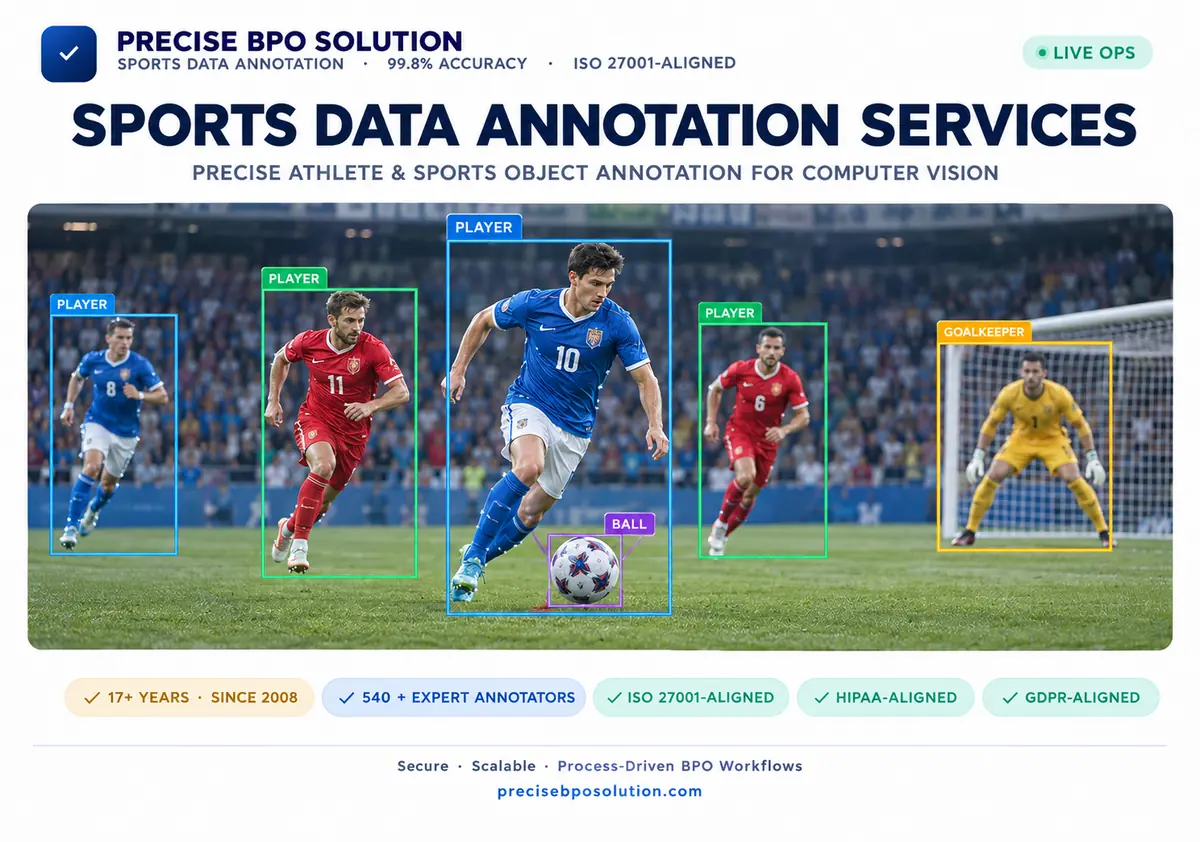
Sports data annotation (also called sports video annotation) is the process of labeling players, balls, referees, jerseys, and field or court geometry in match footage and broadcast video. Each annotation (a bounding box, pose keypoint, or event tag) gives AI and ML models the ground truth needed to track motion, recognize identity, and understand game context frame-by-frame.
It is a core technique in computer vision data labeling, used for player tracking, pose estimation, and event detection in sports analytics and broadcast AI. Unlike static image tagging, sports annotation has to hold player identity through occlusion, camera switches, and crowded plays.
We deliver the labels as per-frame tracking records, usually as COCO JSON, MOT tracking files, CSV event logs, or a custom schema, so they load straight into your analytics and training pipelines.
Since 2017, Precise BPO has labeled sports data for analytics platforms (player tracking), performance-tech companies (pose estimation), broadcasters (event tagging), and fan engagement apps (ball tracking). Our delivery center in Pune, India runs 24/7, and we build each dataset to your model specification. This work is part of our broader data labeling services.
Our annotators specialize in player and ball tracking, applying identity continuity rules, pose keypoint standards, and event-tagging checks to every dataset. We handle footage from broadcast feeds, multi-camera rigs, drones, and CCTV, and we work in your annotation platform and output schema.
For analytics programs that need player tracking across a full season, we label boxes, keypoints, ball position, and event tags through complex multi-player plays, so teams can go from pilot to production without building their own labeling infrastructure.
Sports-tech companies and broadcasters come to us for event tagging, jersey number recognition, and pose estimation across broadcast feeds and stadium cameras. We also tag events for betting data teams building in-game models. We take on season-long work as well as one-off tournament bursts, inside your existing workflow and with no minimum commitment.
We also offer online data entry and data conversion under the same NDA. We also run other computer vision projects, including medical image annotation and fashion annotation.


Analytics, broadcast, betting, and fan-engagement platforms all depend on accurate player and ball tracking data.
Player tracking, pose estimation, and possession data for performance dashboards across football, basketball, and cricket. Frame-consistent player IDs for tactical and predictive models.
Player and ball tracking, jersey number recognition, and event tagging from broadcast footage, used to train models for automated graphics overlays and commentary triggers.
Season-long player tracking, formation analysis, and pose data from training and match footage, for performance review, scouting, and injury-risk monitoring.
Event detection, player performance tagging, and statistical extraction from match footage to support fantasy scoring engines.
Event tagging, ball possession tracking, and play-by-play data extraction from recorded match footage, used to train live odds and in-game betting models.
Pose estimation and motion-pattern labeling synced against wearable sensor data, for biomechanics research and athlete performance products.
Clip-level tagging of goals, fouls, and key plays for media teams cutting highlight packages from full-match footage.
Player recognition and event highlights for second-screen apps, social clips, and personalized content recommendations.
Some clients also send us data entry work alongside annotation, such as market research data entry, registration forms, and survey data entry.
Your choice of annotation type affects model performance and labeling cost. The table below compares tracking, boxes, and segmentation. For more on boxes, see our bounding box annotation guide.
| Criteria | Player Tracking (Sports Annotation) | Bounding Box | Semantic Segmentation |
|---|---|---|---|
| Shape | Tracked box (plus keypoints) with a persistent player ID | Rectangle (axis-aligned or rotated) | Pixel-level mask per class |
| Best for | Following players, ball, and officials across frames, with pose and event labels when needed | Bounded objects — vehicles, people, products, animals | Separating regions such as pitch, court, crowd, or graphics overlays |
| Annotation Speed | Moderateboxes plus ID review | Fastest — single drag | Slowest — pixel-by-pixel |
| Cost Efficiency | Highscales well with volume | Highest — minimal effort per object | Lowest — intensive per image |
| Output Precision | Tight boxes, stable IDs | Object-level (includes background) | Pixel-perfect |
| Video / Temporal | ExcellentIDs held frame-to-frame | Excellent — fast frame tracking | Very high effort per frame |
| Common Use Cases | Player/ball tracking, broadcast graphics, betting feeds | Retail, ADAS, medical, sports analytics, surveillance | Pitch and court mapping, scene parsing, autonomous driving, medical imaging |
| Precise BPO Service | This page — Sports Data Annotation | Bounding Box Annotation | Semantic Segmentation |
Not sure which annotation type fits your project? Talk to our team and we'll recommend the right approach based on your classes, model architecture, and dataset requirements. For movement-path data such as player runs or ball trajectories, we also offer polyline annotation services.
We label players and balls using bounding box annotation, pose keypoint labeling, and event tags. Most of our sports datasets are high-volume and multi-class, and player IDs have to stay consistent across analytics and broadcast pipelines.

Our annotators work from sport-specific guidelines covering movement patterns, formations, and rules, so identity, possession, and event tagging hold up.
Don't see your sport listed? Tell us which sport you need. We can onboard new sport rule sets and class taxonomies during the pilot.
Six steps, from scoping and footage intake to final delivery.
We agree annotation goals, player and event classes, pose keypoint standards, identity continuity rules, and output schemas with your AI or analytics team before labeling begins.
Match footage and broadcast feeds arrive by encrypted transfer, are normalized to standard formats, frame-synced where required, and split into batches on secured, access-controlled infrastructure under NDA.
Specialized annotators track players and the ball using your keypoint density, identity rules, and event taxonomy, in the annotation platform of your choice or our own tooling. Video is annotated frame-by-frame to keep tracks continuous.
3-tier QC covering identity verification, alignment audits, frame sampling, and reviewer sign-off. Automated checks flag tracking issues for reviewers.
We submit annotated batches for your review and fold feedback into structured revision cycles, so quality stays aligned as guidelines and requirements change.
Outputs are delivered by secure transfer in your required format: COCO JSON, MOT tracking files, CSV, or custom. We also support active learning pipelines, model retraining cycles, and longer annotation engagements.
Examples from sports-tech and broadcast projects.
We work in your existing annotation tools or recommend a stack that suits the project. Our annotators are trained on CVAT, Labelbox, and other major platforms, so you don't have to change tools to work with us.
Our in-house team handles player tracking, pose estimation, ball tracking, and event tagging for sports-tech and broadcast clients worldwide, with consistent player IDs and fast turnaround.
Start a Free PilotAI data labeling since 2017 and data entry since 2008, with sports work that runs from simple player boxes to multi-player pose and event tracking.
Our annotators are full-time employees, not crowdsourced workers, and the same QA applies from a small pilot to a full season.
Access control, NDA-bound workflows, and automated security audits keep your match footage and player datasets protected.
Backed by our 3-tier QA process, so player and ball tracks hold up batch after batch.
India-based delivery, no hidden fees, and a free pilot batch before you commit.
We work inside your preferred tooling (CVAT, Labelbox, V7, SuperAnnotate) and deliver in COCO, MOT, YOLO, or any client-defined schema.

Every dataset passes three mandatory quality gates before delivery. The tiers catch bounding box drift, identity-swap errors, and keypoint misplacement early, before they carry into later batches.
Our annotation governance process sets the guidelines each tier checks against.
The annotator does a first pass, then a senior peer cross-checks it. Together they catch bounding box drift, identity swaps, missed occlusions, and guideline deviations before any automated scoring.
An automated layer validates box and keypoint geometry, checks identity continuity, detects broken or swapped tracks, and flags statistical outliers across the batch for human re-review.
The QA lead samples each batch and reviews every frame on high-stakes projects. Client feedback is built in: corrections are applied and re-verified before sign-off and delivery.
This compares in-house teams, generic BPOs, and Precise BPO on the criteria AI and procurement teams ask about most. For a wider view of the market, see our comparison of top data annotation companies.
| Criteria | In-House Team | Generic BPO | Precise BPO Our approach |
|---|---|---|---|
| Annotation Accuracy | 85–92% (varies with QC setup) | 90–94% (identity tracking varies) | Target of up to 99.8% — 3-tier QA pipeline |
| Setup Time | 6–10 weeks (hire, train, tool) | 3–5 weeks | Pilot starts within 48 hours after the NDA is signed; pilot delivery takes 24–48 hours, where applicable |
| Scalability for Surge Volumes | Fixed headcount, slow ramp | Limited, delays common | 540+ in-house team, fast ramp-up |
| Cost | Baseline (salary + infra) | Lower than in-house, varies by vendor | 40–60% below US/UK rates |
| Security & Compliance | Varies by team | Varies by vendor | ISO 27001- and GDPR-aligned workflows |
| Multi-Camera & Broadcast Feed Handling | Depends on tooling | Varies by vendor | Broadcast, multi-camera, drone & CCTV ready |
| Player Identity Continuity Across Frames | Possible, but slower to set up | Often limited | Persistent player and ball IDs across frames |
| Free Trial / Pilot | Usually no pilot stage | Rarely offered | Free pilot batch, no commitment |
Pricing depends on your volume and timeline, with no platform fees and no lock-in. Every engagement starts with a free pilot batch.
Our delivery center runs 24/7, so work can be handed back within your working day, whichever region you are in.
What sports-tech, broadcast, and analytics teams say about working with us.
What AI and analytics teams usually ask before starting a pilot.
It gives computer vision models the ground truth for tracking players and balls, reading formations, and following possession through a match. Performance analytics, broadcast automation, and fan engagement products all depend on it. Our guide to data labeling gives broader context.
Broadcast TV feeds, stadium multi-camera rigs, drone footage, training-ground CCTV, and mobile match recordings all work. If you're unsure about a particular source, send us a short sample and we'll tell you whether it's suitable.
Labeled player IDs, keypoints, and ball positions let models learn trajectories, pose, and possession across frames. Teams use that to work out speed and formation changes, and to build heatmaps, performance scores, and automated highlights.
We split large projects into batches, typically by match, round, or camera set, and every batch follows the same versioned guidelines and class definitions. Structured review cycles and incremental updates let teams scale volume and keep training data current over a full season without annotation drift.
Mostly sports analytics platforms, broadcasters, professional leagues, fantasy sports and betting providers, and wearable performance-tech companies, each using tracking data for a different purpose. See the industries section above for what we label for each.
We use predefined annotation guidelines, identity continuity rules, pose keypoint standards, and event class definitions. Reviewers check identity continuity through occlusion, camera switches, and crowded plays, and 3-tier review keeps the same player on the same ID across clips. Our annotation governance process sets out how we apply these standards.
We usually deliver COCO JSON, MOT tracking files, CSV event logs, or custom schemas. These load into PyTorch and TensorFlow pipelines and most sports analytics tools. Structured outputs let teams validate player IDs and use the data directly for training.
Pricing depends on footage volume, number of tracked players, pose keypoint density, frame rate, and review depth. Common models include per-image, per-frame, hourly, or monthly retainer. Our India-based delivery typically costs 40–60% below US/UK rates. Our data labeling pricing guide has typical ranges, or you can request a tailored quote.
Our workflows are ISO 27001- and GDPR-aligned, with stricter handling where footage includes athlete health or biometric data. All annotators sign NDAs before project access, roles are permission-scoped, and automated security audits run across all project environments.
Practical guides on data labeling, annotation pricing, and vendor selection for AI and ML teams evaluating annotation partners.
Tell us what you're labeling and we'll scope a pilot. We can bundle annotation, our other labeling work, and data entry into one engagement. You can also meet the Precise BPO team before you send a request.
Get a response within one business day, with no commitment required.
Our team will review your requirements and respond within one business day.