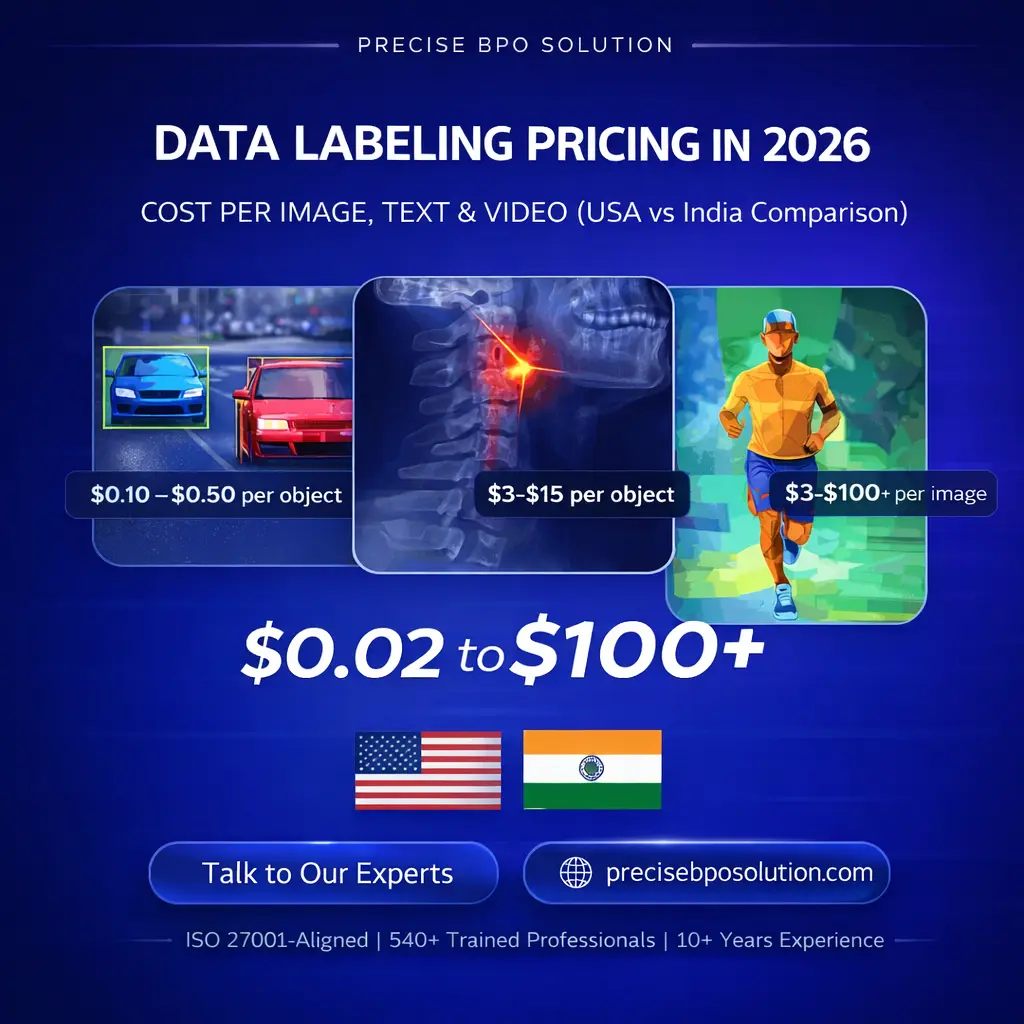
Why Data Labeling Costs Are Rising in 2026
Companies spend 60–80% of their AI budget on data labeling — also called data annotation pricing or data annotation cost — yet most still underestimate its true cost. As AI adoption accelerates across healthcare, automotive, retail, and finance, demand for high-quality training data annotation is outpacing supply of skilled annotators, pushing annotation pricing and data labeling rates 2026 benchmarks upward across all task types. Every machine learning data labeling pipeline depends on reliable ground truth data — and the cost of producing that ground truth has become one of the most significant variables in any AI development budget. Precise BPO's full-spectrum data labeling services are built around this reality, with pricing structures designed for both high-volume commodity annotation and specialist domain tasks.
Data labeling pricing complexity has also increased. In 2023, most enterprises could budget $0.05–$0.15 per image for basic computer vision data labeling. In 2026, the spread of annotation cost per image is far wider — from $0.02 per bounding box annotation to $100+ for complex medical imaging segmentation — driven by rising quality expectations, domain expertise requirements, and compliance overhead for regulated industries. Object detection annotation cost and image annotation cost now reflect the premium placed on pixel-level accuracy and multi-class consistency. The same widening spread applies to data annotation for text and video, where rate cards now vary by task complexity far more than they did even two years ago. Planning a realistic data labeling budget requires understanding this full spectrum before committing to a vendor.
The cost of data labeling is not simply a rate per label — it is cost per accurate label at production quality. A vendor quoting $0.01 per record with a 20% error rate costs more than a vendor quoting $0.04 per record with a 1% error rate, once rework and retraining cycles are factored in. This annotation pricing guide is built around that principle: total project cost, not headline rate.
Understanding real-world annotation cost requires evaluating four variables simultaneously: annotation type, geographic location of the team, quality control overhead, and domain specialisation. This guide covers all four — with real pricing benchmarks from 17+ years of enterprise AI data annotation delivery, established 2008, aligned with ISO 27001, HIPAA, and GDPR standards. Note that for teams whose core need is high-accuracy online data entry outsourcing rather than annotation, cost drivers differ significantly — volume, form complexity, and turnaround matter more than annotation type. Similarly, teams handling large-scale document digitisation workflows may also benefit from Precise BPO's data conversion services, which sit alongside annotation in an integrated data operations pipeline. For a broader primer on how annotation fits into AI workflows, our guide to what data labeling actually involves is a useful starting point before evaluating annotation-specific pricing.
Data Labeling Cost Per Annotation Type — Complete Reference
The following pricing ranges reflect real-world enterprise annotation rates 2026, based on market benchmarks and operational data from annotation projects across computer vision, NLP, and video datasets. All prices are per unit (object, record, or frame) unless specified. Use this table as a quick reference for image annotation pricing, image annotation cost, text annotation cost, and video annotation pricing side by side — from bounding box annotation cost at the low end to semantic segmentation cost and medical imaging at the high end. Whether you are building a model training dataset from scratch or expanding an existing data pipeline, these benchmarks give you a defensible starting point for budget planning across every major annotation type.
| Annotation Type | India Rate | USA Rate | Complexity |
|---|---|---|---|
| Bounding Box Annotation | $0.02–$0.10/obj | $0.10–$0.50/obj | Low |
| Polygon Annotation | $0.05–$0.50/obj | $0.50–$3.00/obj | Medium |
| Semantic Segmentation | $0.50–$3/obj · $3–$15/img | $3–$15/obj · $15–$100+/img | Very High |
| 3D Cuboid / LiDAR Annotation | $0.50–$2.00/obj | $2.00–$8.00/obj | High |
| Polyline / Lane Detection | $0.05–$0.30/line | $0.30–$1.50/line | Medium |
| Landmark / Keypoint Annotation | $0.03–$0.20/set | $0.20–$1.00/set | Medium |
| NLP / Text Annotation | $0.01–$0.05/record | $0.05–$0.20/record | Low–Med |
| LLM Fine-Tuning Data | $0.05–$0.30/record | $0.30–$1.00+/record | High |
| Video Object Tracking | $3–$15/hr footage | $15–$60/hr footage | Very High |
| Frame-by-Frame Video Annotation | $0.05–$0.25/frame | $0.25–$1.00+/frame | High |
| Medical Imaging Annotation | $2–$20/image | $20–$150+/image | Very High |
| Medical De-identification | $0.10–$0.50/record | $0.50–$2.00/record | High |
Semantic segmentation requires pixel-level accuracy across every boundary in an image. A single complex urban scene can take 45–90 minutes to annotate properly, versus 2–4 minutes for bounding box annotation of the same image. QA effort is proportionally higher, as pixel errors compound across class boundaries in ways that bounding box errors do not.
For autonomous vehicle annotation, pricing is driven by both complexity and compliance — 3D LiDAR annotation cost and HD map labeling require domain-trained annotators and multi-layer validation, pushing costs to the higher end of the ranges above. Object detection annotation cost for automotive and robotics projects sits at the complex end of the bounding box and polygon annotation cost spectrum. For precision agriculture AI annotation and retail product image annotation, complexity is lower and India-based teams deliver strong cost-quality outcomes at scale. Our retail data annotation workflow guide explains how high-SKU product catalogs are annotated efficiently at volume without accuracy trade-offs. For medical AI pipelines, medical imaging annotation cost carries a separate structure driven by credentialed annotator requirements — see medical imaging annotation and HIPAA-aligned de-identification services for details.
Healthcare data labeling project cost typically runs 3–10× higher than general computer vision annotation, driven by credentialed clinical reviewers, HIPAA-aligned handling, and multi-pass QA. The average cost of data labeling project healthcare teams should budget for varies by modality — DICOM radiology annotation costs more than clinical NLP labeling. Data labeling project cost healthcare organizations actually pay includes per-study radiologist review and de-identification, not just a flat per-image rate. And data labeling quality assurance cost per project healthcare teams underestimate is the single biggest driver of budget overruns in regulated AI programs.
USA vs India: When Each Makes Sense
The 60–80% cost differential between US-based and India-based data annotation is well established. What is less discussed is the specific conditions under which each geography delivers the better outcome in a USA vs India data labeling comparison — and when it actually makes sense to outsource data labeling to India versus keeping it domestic, including cases where the lower-cost option actually costs more when total project cost is calculated accurately. Getting data labeling outsourcing right hinges less on geography and more on vendor governance quality.
India-Based Annotation
- 60–80% lower cost than US-based equivalent annotation
- Large scalable workforce — rapid team ramp-up for high-volume projects
- Mature outsourcing ecosystem with ISO 27001-aligned data security
- Strong computer vision and NLP annotation capability at enterprise scale
- 540+ expert annotation teams available for immediate project deployment
- HIPAA and GDPR-aligned workflows for regulated industries
USA-Based Annotation
- Native English expertise for nuanced NLP, sentiment, and LLM tasks
- Domain experts for highly regulated industries — clinical, legal, financial
- Easier compliance documentation for US-regulatory requirements
- Lower communication overhead for complex real-time collaboration
- Required for certain government and defense AI datasets
- Data residency requirements for US-jurisdiction projects
Real Cost-Quality Outcomes: India vs USA for Enterprise Annotation Projects
Across annotation projects delivered over 17+ years, India-based annotation with structured governance achieves equivalent or superior accuracy to US-based annotation at 20–35% of the total cost, across standard computer vision and NLP tasks. The critical variable is governance quality — not geography.
Source: Precise BPO Solution operational data, aggregated across enterprise annotation projects, 2023–2025. Individual project results vary by task complexity and domain.
This is why vendor selection should always evaluate cost-per-accurate-label — not cost-per-label. A scalable enterprise data labeling service that integrates with your existing annotation platform and delivers consistent quality at volume is worth far more than the apparent savings from the cheapest per-label rate. When teams outsource annotation to governed India-based vendors, the combination of lower annotation outsourcing cost and mature QA infrastructure consistently outperforms ungoverned alternatives — whether the project is computer vision, NLP data labeling, or video tracking. Our annotation governance framework is specifically designed to keep error rates below 2.1% across all annotation types, regardless of volume. For teams also managing structured data operations alongside AI annotation, scaling online data entry at volume follows similar cost-quality trade-off logic — governance quality is the primary cost lever in both disciplines.
What Drives Data Labeling Costs Higher
Six factors account for the majority of variation in data labeling cost. Understanding which of these apply to your project is the foundation of accurate annotation budget planning and AI training data pricing for enterprise AI initiatives.
Annotation Complexity
Polygon and segmentation tasks cost 5–50× more than bounding box on the same image. Complexity is the single largest cost driver across all annotation types and geographies.
Domain Expertise Required
Medical, legal, and financial annotation requires credentialed domain experts — physicians, lawyers, compliance specialists — adding 3–10× to base annotation cost for AI training data. LLM fine-tuning data cost and LLM annotation cost follow a similar curve, rising sharply once subject-matter review and RLHF preference ranking are added to a project. Unlike crowdsourcing annotation where task complexity is kept simple to maintain quality, domain-expert tasks require managed specialist teams with structured QA — a fundamentally different cost model.
QA Layer Depth
Multi-layer QA — primary annotation, secondary review, senior arbitration — adds 30–60% to base annotation time but is essential for production-grade 99.8% accuracy.
Dataset Size & Turnaround
Rush turnarounds (48–72 hours) typically carry a 20–40% premium. Large datasets (1M+ samples) often qualify for volume pricing that reduces per-unit cost by 15–30%.
Multi-Class Complexity
Datasets with 20+ classes are significantly harder to annotate consistently — boundary ambiguity increases exponentially with class count, driving up both annotation and QA time.
Compliance Overhead
HIPAA, GDPR, and ISO 27001-aligned workflows add process overhead but not dramatically to per-label cost when the vendor already has the right data handling infrastructure in place.
For sports action recognition annotation and fashion and apparel annotation, complexity is moderate and volume pricing applies strongly — these are ideal candidates for India-based annotation at scale. For explicit content moderation annotation, psychological welfare requirements and calibration overhead are significant cost drivers that many teams underestimate in their initial annotation pricing models. Teams evaluating third-party vendors for the first time can benchmark options in our independent comparison of top data annotation companies — it covers quality benchmarks, pricing structures, and domain specialisations. For teams whose data operations span AI annotation and document-based processing, Precise BPO's online data entry outsourcing services and document data conversion run on the same quality framework as our annotation pipelines — making it practical to consolidate both workstreams under a single governed vendor without sacrificing accuracy in either discipline. If data entry outsourcing is also on your roadmap, our comparison of top data entry companies applies the same evaluation framework used above for annotation vendors.
How to Reduce Data Labeling Costs Without Sacrificing Quality
The most effective cost reduction strategies operate at the pipeline level — reducing unnecessary labeling work rather than reducing annotation quality. Teams asking how much does data labeling cost can find affordable annotation options at scale by applying these five approaches, which consistently deliver the best cost-quality outcomes across enterprise annotation projects in 2026.
AI-Assisted Pre-labeling with Human Validation
Use a lightweight model to generate initial annotations, then have human annotators validate and correct rather than label from scratch. This human-in-the-loop approach reduces annotation time by 40–60% on structured tasks (bounding box, classification) while maintaining production-grade annotation accuracy through human oversight. Effective for bounding box and text classification at scale, and particularly valuable for object detection datasets where large volumes of similar frames can be pre-labeled efficiently.
↓ 40–60% annotation time reductionActive Learning Pipelines
Train an initial model on a small labeled subset, then use it to identify which unlabeled samples are most informative (highest model uncertainty). Label those first. Active learning consistently reduces the total number of samples requiring human annotation by 30–50% for equivalent model performance — a direct reduction in AI training data cost. This technique is especially powerful for object detection and image labeling projects where the dataset is large but label budget is fixed.
↓ 30–50% samples to labelStandardised Annotation Guidelines at Project Intake
Projects with clear, version-controlled annotation guidelines applied before labeling begins require 74% less rework than projects where guidelines are developed reactively. The cost of guideline development is recovered within the first batch. See our version-controlled annotation guidelines framework for the full methodology.
↓ 74% less reworkStrategic Outsourcing to Governed India-Based Teams
Outsourcing to a vendor with mature QA infrastructure — not simply the lowest-cost provider — delivers 60–80% cost savings with production-grade accuracy. In an honest in-house vs outsourced comparison, the total data labeling outsourcing cost almost always comes out lower once hiring, training, and attrition are factored into an in-house build. Teams that experiment with freelance annotators or unmanaged crowdsourcing annotation typically discover that per-label rates look attractive but per-accurate-label costs are high once rework is included. The key distinction is whether the vendor tracks inter-annotator agreement (IAA) and applies version-controlled labeling policies — and whether their annotation platform integrates cleanly with your existing ML pipeline. Without these, the cost saving is often erased by rework. Precise BPO Solution — India's enterprise data operations partner since 2008 — is ISO 27001, HIPAA, and GDPR aligned for secure enterprise delivery, covering both AI data labeling and annotation services and scalable online data entry outsourcing under a single quality framework.
↓ 60–80% cost vs US-basedAnnotation Type Selection — Match Precision to Requirements
Semantic segmentation is not always necessary where polygon annotation delivers sufficient precision. Polygon is not always necessary where bounding box meets model requirements. Systematically selecting the minimum-complexity annotation type for each task — verified against model performance benchmarks — reduces total annotation cost by 20–40% on mixed-complexity datasets.
↓ 20–40% total annotation costHow to Choose the Right Data Labeling Partner
Vendor selection for data labeling services is not primarily a price negotiation — it is a quality infrastructure assessment, and understanding data labeling pricing in this context means evaluating cost alongside governance, not in isolation. Whether you call it a data labeling vendor or a data labeling company, the five criteria below are the most predictive of long-term annotation quality and total project cost. A scalable, well-governed partner accelerates your machine learning timeline; an ungoverned one quietly erodes it. This applies across every workload — computer vision annotation, NLP data labeling, video tracking, or RLHF — regardless of quoted rate.
Ask how they measure inter-annotator agreement (IAA), what their kappa targets are, and how frequently they run calibration sessions. Vendors without formal IAA tracking cannot guarantee consistent quality at scale — this is non-negotiable for enterprise annotation projects.
Request accuracy data specific to your annotation type — bounding box, segmentation, NLP — not aggregate claimed accuracy. A 99.8% accuracy claim on simple classification is not equivalent to 99.8% accuracy on semantic segmentation. Demand task-specific evidence.
Understand team size, peak delivery capacity, and how quickly they can scale from 10K to 1M labeled samples. Bottlenecks at scale are a common source of hidden cost that doesn't appear in initial data labeling quotes.
Medical, automotive, retail, and NLP annotation each require different expertise. Generic annotation teams frequently underperform on domain-specific tasks — even when general accuracy metrics are high. Verify with task-type samples before committing to a project.
ISO 27001 alignment, HIPAA-aligned data handling for medical datasets, and GDPR-aligned data processing are non-negotiable for enterprise clients. Ask for documented evidence of alignment, not just vendor claims. All Precise BPO Solution projects are ISO 27001, HIPAA, and GDPR aligned.
Ask any prospective vendor: "What is your inter-annotator agreement measurement process, and what kappa score do you target?" A vendor without a clear answer does not have a mature quality control framework — regardless of what their marketing materials say. This single question filters out the majority of low-quality vendors in the annotation market.
Precise BPO team applies a six-layer annotation governance framework across all enterprise projects. Our IAA target is κ ≥ 0.85, with an alert threshold at κ < 0.80 that triggers immediate calibration review. Across 500K+ audited annotations, our framework has consistently achieved annotation inconsistency rates below 2.1% with 99.8% accuracy. For teams comparing vendors before committing, our top data annotation companies guide gives a balanced view of how leading providers differ on quality, pricing transparency, and domain specialisation. Explore Precise BPO's full data labeling service portfolio →
So, how much does data labeling cost in practice? The honest answer is "it depends on complexity, geography, and governance" — but the benchmarks in this guide give you a defensible starting point for enterprise data labeling pricing, whether you are budgeting AI training data cost for a computer vision self-driving dataset or NLP annotation cost for an LLM fine-tuning pipeline. The right partner will also advise on annotation tool compatibility with your existing workflow — ensuring the labeled data they deliver integrates cleanly with your ground truth management system — rather than simply quoting a flat per-label rate.
For specific annotation services: object detection bounding box services, pixel-level segmentation services, polygon annotation, medical AI annotation, automotive annotation, text annotation, 3D cuboid annotation, and retail AI annotation.
Get Exact Pricing for Your Dataset
Share your annotation type, volume, and quality requirements. We'll provide a detailed cost breakdown within 24 hours — no obligation.
What Enterprise Teams Say
"We compared four vendors on the same segmentation pilot. Precise BPO delivered the highest accuracy at roughly a third of the cost. The IAA scores they shared were real — not marketing numbers."
"Switching to Precise BPO for our medical imaging annotation cut our cost per DICOM study by 68%. Their HIPAA-aligned handling gave our compliance team zero concerns. Turnaround is consistent and scalable."
"The annotation governance framework they use made a real difference — we went from 8% rework rate with our previous vendor to under 1.5%. That alone paid for the first quarter."
"We labelled 1.2M retail product images across 340 SKUs. Precise BPO onboarded a team of 80 within a week and maintained 99.8% accuracy throughout. Best outsourcing decision we've made."
Data Labeling Pricing — Questions & Answers
Related Articles
Explore more of our data labeling and data entry blog library for pricing benchmarks, governance frameworks, and vendor comparisons.
Get an Exact Annotation Pricing Quote
Tell us your project requirements and we'll provide a detailed cost breakdown within 24 hours — no commitment required. Serving enterprises across US · UK · Canada · Australia · Europe · Middle East · APAC · LATAM
Thank You — We'll Be in Touch!
Your quote request has been received. A member of our team will respond with a detailed cost breakdown within 24 hours.
For urgent enquiries, reach us directly at info@precisebposolution.com or WhatsApp +91 7972620994.