Annotation Governance: Stop Label Drift in ML Models
Label drift reduces ML accuracy over time. Learn how our 6-layer governance framework helps detect, measure and prevent it.
Secure, high-accuracy explicit content annotation for AI moderation, trust & safety, and NSFW detection models — with 17+ Years Since 2008, 540+ trained reviewers, 810M+ images and related data assets processed. ISO 27001-Aligned, HIPAA-Aligned & GDPR-Aligned workflows for global enterprises.
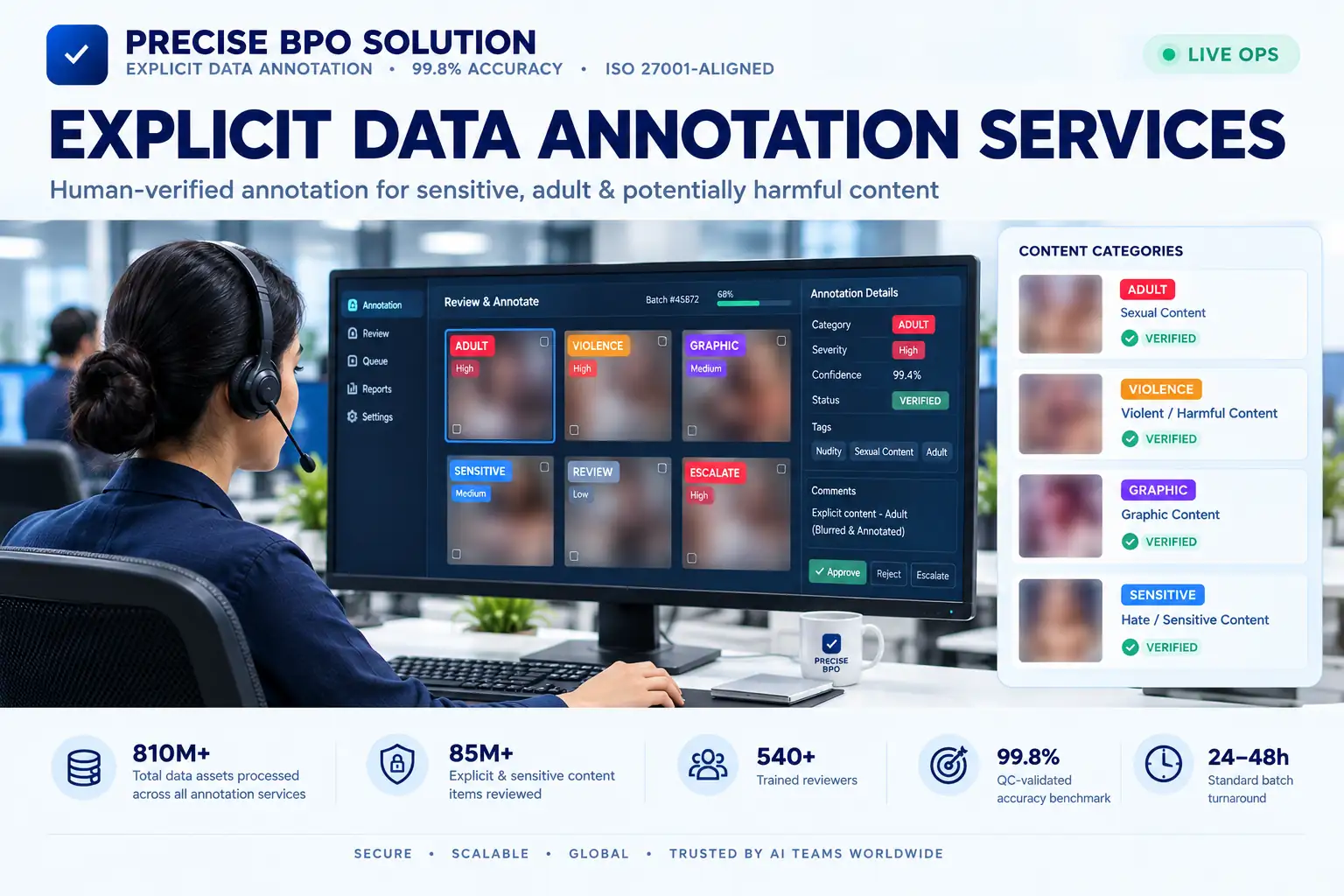
Why Global AI Teams Trust Precise BPO for Explicit Content Annotation
Serving enterprises across US · UK · Canada · Australia · Europe · Middle East · APAC · LATAM
Explicit content annotation — sometimes called explicit data annotation — is the manual review and classification of images, videos, text, and synthetic media to identify nudity, violence, hate symbols, NSFW material, and other sensitive content. Each annotation — severity tag, category label, or contextual flag — gives AI moderation models the ground truth needed to detect policy-violating content and route it for the correct enforcement action, item by item.
It is the primary technique used across computer vision and text data labeling for trust and safety AI, social media and OTT moderation platforms, safe search training data pipelines, and brand safety tooling. As a specialized form of sensitive data labeling, it must hold contextual and cultural consistency across borderline cases — making it essential for reducing false positives, protecting reviewer wellbeing, and keeping moderation pipelines defensible under platform policy and regulatory review.
These outputs are structured as per-item moderation records — typically delivered as structured JSON, CSV exports, or custom schemas — delivering data that maps directly into automated enforcement systems, human review queues, and live trust and safety dashboards.
Since 2008, Precise BPO has delivered explicit content annotation services across content classification for social platforms, severity tiering for streaming and OTT services, text and metadata review for gaming and UGC communities, and synthetic-media detection for AI safety teams — all from our Pune, India delivery centre running 24/7 across global time zones. Read more about Precise BPO and the trust and safety reviewers behind every batch. As a trusted annotation service provider in India, we build every moderation dataset to your exact policy specification.
Our reviewers specialize in trust and safety classification — applying contextual-consistency rules, severity taxonomies, and bias-controlled review protocols that ensure every human-reviewed explicit content dataset is production-ready. We handle data from social platforms, streaming services, gaming environments, and AI training pipelines — adapting to your moderation tooling and output schema without switching costs.
For trust and safety programs requiring high-volume content review across millions of items, we deliver category-accurate annotation labels at scale — covering image, video, text, and synthetic media across complex multi-policy taxonomies. Our outsourcing model lets social media, OTT, and AI safety teams ramp from pilot to production without building in-house moderation infrastructure, reducing per-item costs by 50–60% against US or UK equivalents. Every delivered batch is production-grade AI training data ready to feed directly into your pipeline.
Social media, streaming, and AI moderation enterprises trust us for accurate content classification, severity tracking, and bias-controlled review across cross-platform and multi-format datasets. Whether your team needs ongoing annotation outsourcing to India for continuous moderation queues, or a burst-capacity partner during a policy update, Precise BPO integrates directly into your existing workflow — no tool migration, no ramp-up friction, no minimum commitment. Our India annotation services and BPO annotation services are used by AI teams across 27+ countries. Teams that also need structured online data entry services or data conversion services alongside their annotation work can source all three under one NDA and compliance framework. The same reviewer pool also supports text and NLP annotation and data de-identification programmes for clients running multiple trust and safety pipelines in parallel.
Moderation datasets power trust and safety, brand protection, and AI compliance platforms across the US, UK, and EU — enabling scalable global systems that rely on precise, bias-controlled content intelligence.
Improve content moderation, harassment detection, and policy enforcement on user-generated content with structured explicit image annotation, video, and text classification datasets at scale.
AI-driven video frame review, age-rating verification, and graphic-content flagging — delivered as a scalable video moderation service for safer catalog distribution and regional compliance.
In-game chat, avatar imagery, and user-generated asset review for harassment detection, age-appropriate content, and platform safety automation — often paired with CAPTCHA verification data entry to block bot-driven abuse.
Tag uploaded media, discussion threads, and user submissions — often paired with dedicated text annotation workflows — to keep learning environments safe for all ages.
Label training and evaluation datasets for safety classifiers, generative-model guardrails, and AI-powered moderation product development.
Precise datasets for ad-placement screening, brand-adjacency risk scoring, and creative-asset review — powering brand safety AI systems that protect advertiser reputation at scale.
Standardize evidentiary and compliance-review datasets across platforms and jurisdictions to support audit-ready, defensible moderation records — often processed alongside legal document data entry for case files and evidentiary logs.
Robust multimodal annotation datasets — spanning image, video, and text — supporting trust and safety research and advanced machine learning model development.
Review type selection directly impacts model performance and labeling cost. This comparison helps trust and safety and ML teams choose the right approach based on their content format, policy scope, and pipeline requirements. For a deeper breakdown, see our annotation governance guide. Once you know which review type fits your data, the next decision is who reviews it — see how in-house, generic BPO, and Precise BPO compare further down this page.
| Criteria | Image Review | Video / Frame Review | Text & Metadata Review |
|---|---|---|---|
| Unit Reviewed | Single still image or thumbnail | Sequential frames sampled across a clip | Captions, comments, usernames, tags |
| Best for | Uploaded photos, profile media, ad creatives | Streamed video, livestream clips, OTT catalog | Comments, chat logs, listing descriptions |
| Review Speed | Fastest — single-pass classification | Moderate — frame-sampling workflow | Fast — keyword and context scan |
| Cost Efficiency | Highest — minimal effort per item | Moderate — scales with run-time | High — scales well with volume |
| Context Precision | Item-level (single frame context) | Temporal context across scene changes | Linguistic & cultural context-aware |
| Synthetic / Generated Media | Strong — still-frame artifact detection | Good — frame-by-frame artifact tracking | N/A — applies to caption-level signals only |
| Common Use Cases | Profile photos, ad creatives, marketplace listings | OTT catalogs, livestreams, UGC video uploads | Chat moderation, comment review, listing text |
| Precise BPO Service | Image Moderation Annotation | Video Moderation Annotation | Text & NLP Annotation |
Not sure which review type fits your project? Talk to our explicit content annotation specialists — we'll recommend the right approach based on your platform, content mix, and policy requirements. For dedicated linguistic review of comments and listings, see our text annotation services as well.
Expert content classification and severity labeling covering image moderation, video content moderation, text moderation, and synthetic media review. Whether you need a standalone image annotation service or full-pipeline adult content moderation support, our workflows are built for high-volume, multi-policy trust and safety datasets that need contextual accuracy across social media, OTT, gaming, and enterprise AI moderation pipelines.

Our reviewers are trained on the content taxonomies, severity frameworks, and cultural context standards specific to each media type and platform policy — so classification stays consistent and defensible across every batch.
Don't see your content type listed? Discuss your custom taxonomy with us — we onboard new policy taxonomies and severity schemas as part of every pilot.
Structured workflow covering requirement understanding, data ingestion, content classification, severity tiering, multi-stage QC, client review, and final delivery — optimized for 99.8% accuracy at scale.
Analyze platform policies, content taxonomy, severity framework, dataset volume, and review complexity to define a tailored moderation labeling strategy for AI-ready datasets, before any review begins.
UGC images, video clips, and chat or caption text are received via encrypted transfer, deduplicated, and pre-screened for known-violation matches before being queued for severity-tiered review under NDA-bound, ISO 27001-Aligned infrastructure.
Specialized reviewers classify images, video frames, and text content using client-defined severity taxonomies — applying contextual rules, cultural-context checks, and bias-controlled review protocols using annotation platforms of your choice or our internal tooling.
Multi-layer QC covering policy-consistency checks, severity-accuracy audits, batch sampling, and reviewer sign-off. Automated checks flag category mismatches before human review — enforcing 99.8% accuracy on every batch.
Sample moderation datasets are reviewed and refined based on client feedback through structured revision cycles — maintaining policy alignment across evolving guidelines and platform moderation requirements.
Clean, structured moderation datasets delivered in JSON, CSV, or custom schemas with severity tags, category labels, and confidence scores via secure transfer. Ongoing support for policy updates, taxonomy expansion, and continuous moderation pipeline engagements.
From social media moderation and OTT safety to gaming platforms and AI safety guardrails — these annotation datasets make trust and safety models production-ready for global enterprise teams.
Platform-agnostic and format-flexible — we work within your existing moderation stack or recommend the right tools for your project. Our reviewers are trained across Hive Moderation, Amazon Rekognition review queues, and several other major platforms used in trust and safety pipelines. No lock-in, no re-tooling overhead.
Precise BPO is an India-based explicit content annotation company and content moderation outsourcing partner with 17+ years of experience since 2008 — delivering accurate, scalable, and cost-efficient trust and safety annotation services to AI, social media, OTT, and gaming teams worldwide. Teams that outsource this work to us get high-accuracy content classification, severity tiering, and bias-controlled review — handled by 540+ in-house reviewers. Trusted across US, UK, Canada, Australia, Europe, Middle East, APAC & LATAM.
Start Your Explicit Content Annotation PilotDeep institutional knowledge of trust and safety workflows — from simple content classification to complex multi-policy severity taxonomies and synthetic media detection — built over nearly two decades.
Dedicated, trained content moderation reviewers delivering precise severity-tiered annotation at enterprise scale — no crowdsourced workers, no quality compromise on any content volume.
Secure access control, NDA-bound workflows, and automated security monitoring ensure your sensitive moderation datasets and platform content stay protected end to end.
Multi-stage QC combining severity validation, policy-consistency checks, peer review, and expert audit — ensuring accurate content classification and severity routing on every batch.
India-based moderation teams deliver the same severity-tiered review quality as in-house US or UK trust and safety teams, at 50–60% lower cost — with no hidden fees and a free pilot batch before any commitment.
We review within your preferred tooling — CVAT, Labelbox, V7, SuperAnnotate — and deliver in JSON, CSV, or any client-defined schema with severity tags and confidence scores.
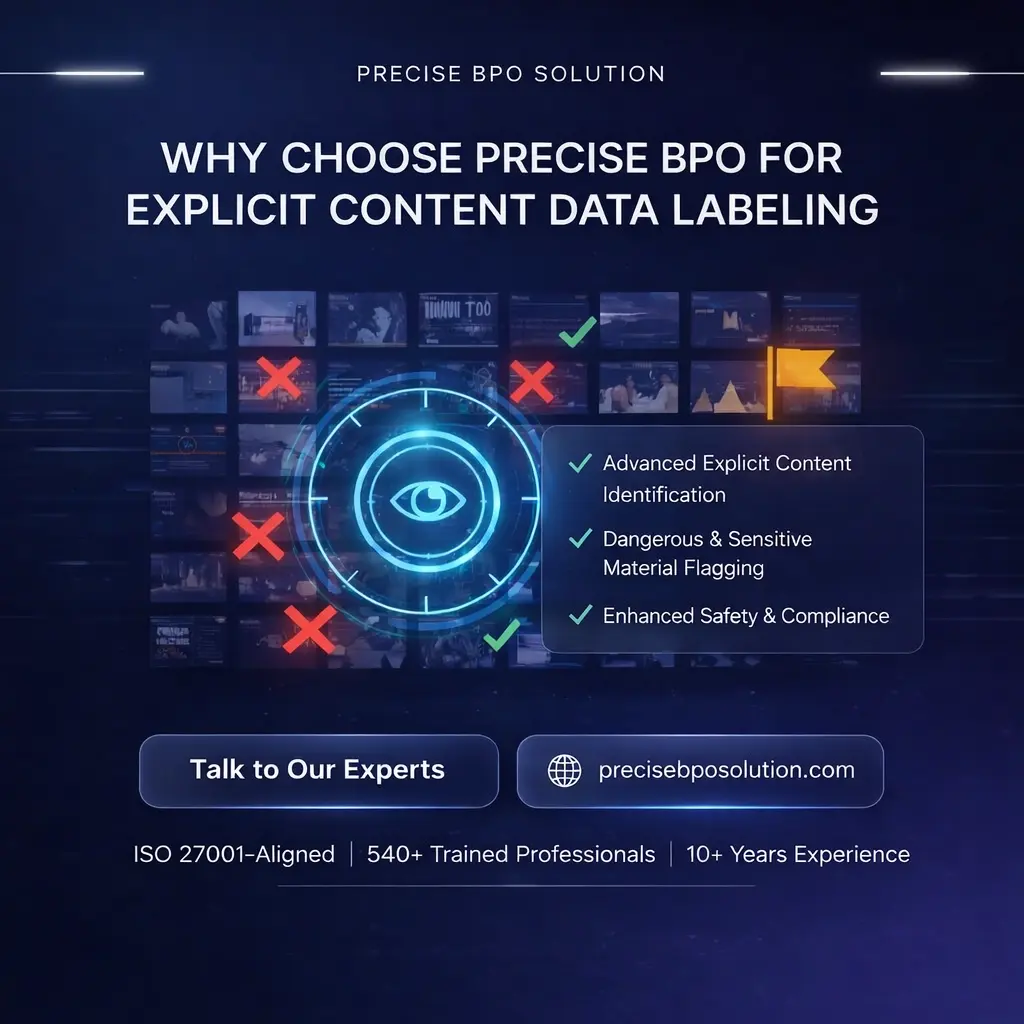
Every moderation dataset passes three mandatory quality control gates before client delivery — sustaining best-in-class accuracy for content classification, severity tiering, and policy-consistency checks. See our annotation governance guide for the full framework.
High accuracy in this domain is not a default outcome — it is the result of disciplined process at every stage.
Human-driven first pass by the reviewer, then cross-checked by a senior peer. Catches category mismatches, severity mis-tiers, missed contextual flags, and guideline deviations before any automated scoring.
Algorithm-driven layer that validates severity-tier assignments, checks category-consistency across multi-format captures, detects conflicting or duplicate labels, and flags statistical outliers across the batch for human re-review.
QA Lead conducts full-batch review on every high-severity escalation and random sampling on standard queues. Disputed severity calls are routed back to the client feedback loop and re-verified before final sign-off and delivery.
For trust and safety leads, AI moderation engineers, and procurement teams justifying outsourcing to stakeholders — a direct, honest comparison with transparent numbers for these projects.
| Criteria | In-House Team | Generic BPO | Precise BPO Recommended |
|---|---|---|---|
| Annotation Accuracy | 78–88% (reviewer fatigue, no severity QC) | 86–92% (inconsistent policy mapping) | ✔ 99.8% — 3-tier severity pipeline |
| Setup Time | 6–10 weeks (hire, train, tool) | 3–5 weeks | ✔ Live in 24–48 hours |
| Scalability for Surge Volumes | ❌ Fixed headcount, slow ramp | ⚠ Limited, delays common | ✔ 540+ team, instant scale for peak content events |
| Cost vs In-House | Baseline (salary + infra) | 25–35% savings | ✔ Up to 60% cost savings |
| ISO 27001-Aligned Security | ❌ Rarely formal | ⚠ Claimed, unverified | ✔ ISO 27001-Aligned, HIPAA-Aligned & GDPR-Aligned |
| Reviewer Wellbeing Protocols | ⚠ Often overlooked | ⚠ Not standardized | ✔ Rotation schedules, escalation paths, structured support |
| Policy Taxonomy Customization | ⚠ Possible but slow | ⚠ Varies by vendor | ✔ Full custom taxonomy & severity-tier configuration |
| Free Trial / Pilot | ❌ Not applicable | ❌ Rarely offered | ✔ Free pilot batch, no commitment |
Transparent pricing for this service — no platform fees, no lock-in. Pricing is structured to fit your content volume, severity mix, and timeline, and all engagements include a free pilot batch before commitment.
Pay per reviewed and classified image. Ideal for defined upload batches, one-off moderation audits, or pilot programs needing predictable per-unit cost.
Priced per video frame. Purpose-built for livestream review, age-rating compliance datasets, and frame-level moderation where frame count is the natural unit of work.
Hourly model for high-complexity review — multi-label severity tagging, contextual policy adjudication, layered text/image/metadata review — where per-image pricing doesn't reflect actual review effort.
A dedicated explicit content moderation team at fixed monthly capacity. Best for social platforms and AI safety teams with continuous review needs across live uploads or active learning pipelines.
Our India-based delivery hub runs 24/7 across time zones — covering US, UK, EU, APAC, Middle East, Australia, Canada, and LATAM with region-specific moderation policy standards and compliance protocols.
Social platforms, streaming services, and AI safety teams worldwide trust Precise BPO India for consistent, scalable, and accurate content moderation support at enterprise scale.
"Precise BPO handles our entire UGC image moderation pipeline for trust and safety. Consistent severity tagging, fast turnaround on flagged content, and the team scales instantly during traffic spikes. 99.8% accuracy holds every single batch."
"We outsourced age-rating frame review across millions of video frames to Precise BPO. The structured outputs integrated directly into our content classification pipeline without a single format issue. Outstanding quality and turnaround."
"Our generative AI safety guardrails improved dramatically after switching annotation providers. Precise BPO's classification of unsafe outputs across text, image, and chat was exactly what we needed — clean, consistent labels with correct severity tags on every item."
"We needed rapid in-game chat and avatar review across a fast-growing player base. Precise BPO's annotation guidelines were exceptional — accurate, scalable, and delivered on schedule with full GDPR-Aligned data handling."
"Exceptional white-label content moderation partner. They operate seamlessly on our platform, meet SLAs consistently, and the accuracy is the best we've seen from any outsourced annotation provider across 4 years of working together."
"Precise BPO India is our long-term partner for full-scale content moderation review. Their cost efficiency vs in-house US teams, ISO 27001-Aligned security, and consistent 99.8% accuracy make them indispensable to our trust and safety pipeline."
Clear answers on explicit content annotation scope, accuracy controls, severity tagging, large-scale moderation queues, security compliance, and pricing.
Explicit content annotation is used to label nudity, violence, hate symbols, and other policy-violating material in images, video, and text. These annotations help AI models recognize unsafe content, classify severity, and route items for review or removal. They are essential for trust and safety, brand safety, and generative AI guardrail systems where precise content classification is required. See our guide to data labeling for broader context.
Explicit content annotation is applied to UGC images, livestream and on-demand video frames, in-game chat logs, AI-generated outputs, and ad creative. These datasets contain nudity, graphic violence, hate speech, and other sensitive data. Annotating such content helps models learn policy classification, severity scoring, and contextual patterns used in moderation and brand safety systems. Teams that also need structured data alongside annotation work can explore our data entry outsourcing guide.
Explicit content annotation enables models to learn visual and textual patterns of policy-violating material across images, video, and chat. By labeling severity tiers, category tags, and contextual flags item-by-item, AI systems can interpret intent, risk level, and required action. This improves moderation queue routing, automated takedown accuracy, and guardrail performance in generative AI platforms.
Large moderation datasets are handled through standardized policy guidelines, batch-based review workflows, and structured escalation cycles. Work is divided into manageable queues while maintaining consistent severity definitions and category taxonomy. This allows teams to scale upload volume, update policy datasets incrementally as new violation patterns emerge, and support long-term model training without annotation drift or inconsistency.
Explicit content annotation is widely used by social media platforms, OTT streaming services, gaming companies, generative AI vendors, and advertising/brand safety agencies. These industries rely on moderation and severity-tagged data to power trust and safety pipelines, age rating compliance systems, and AI guardrails. If you're evaluating providers, our data entry and annotation company comparison guide covers what to look for when shortlisting partners.
Consistency is maintained using predefined policy guidelines, severity-mapping continuity rules, escalation-tier standards, and category class definitions. Reviewers verify classification accuracy through varied content types, edge cases, and ambiguous scenes. Multi-level review ensures the same violation type receives the same severity tag across every batch and channel. See our annotation governance framework for how we enforce these standards on every project.
Explicit content annotations are typically delivered in COCO-style JSON, CSV exports, structured XML feeds, or custom schemas. These formats integrate directly with moderation platforms and enforcement pipelines. Structured outputs allow teams to validate severity mappings and use datasets directly for training, policy auditing, or live moderation queues.
Pricing depends on content volume, severity-tier complexity, modality mix (image, video, text), and review depth. Common models include per-image, per-frame, hourly, or monthly retainer. Our India-based delivery typically offers 50–60% savings versus US or UK providers. See our data labeling pricing guide or request a tailored quote.
Yes. Our workflows are ISO 27001-Aligned, HIPAA-Aligned, and GDPR-Aligned to ensure maximum data security for global trust and safety partners. All reviewers sign NDAs before any project access, roles are permission-scoped, and automated security audits run continuously across all project environments — protecting sensitive and user-generated datasets end to end.
Beyond content moderation, Precise BPO delivers domain-specific data annotation across automotive, agriculture, healthcare, fashion, sports, and retail AI pipelines.
Practical guides on data labeling, annotation pricing, vendor selection, and structured data entry — for AI engineers, ML teams, and trust & safety leads evaluating annotation partners.
Work with experienced India-based teams delivering accurate explicit content annotation for UGC moderation, severity tagging, age-rating compliance, and AI safety datasets — supported by 540+ trained reviewers. Outsourcing to us typically saves 50–60% versus in-house US or UK teams without compromising quality. Our full data labeling services are available under one engagement. Meet the Precise BPO team, see careers at Precise BPO, or request a free pilot or project quote below.
Get a response within 24 hours — no commitment required.
Our team will review your requirements and respond within 24 hours. We look forward to powering your trust & safety and content moderation datasets.