What Is Data Labeling? Enterprise Guide
Learn what data labeling is, its types, AI use cases, quality standards, and how enterprises scale annotation for ML.
Secure, scalable de-identification for healthcare, finance, automotive, and smart city AI projects — 17+ Years Since 2008, 540+ trained specialists, and 20M+ images de-identified — ISO 27001-Aligned, HIPAA-Aligned & GDPR-Aligned workflows for SBU, MBU & Enterprise clients worldwide.
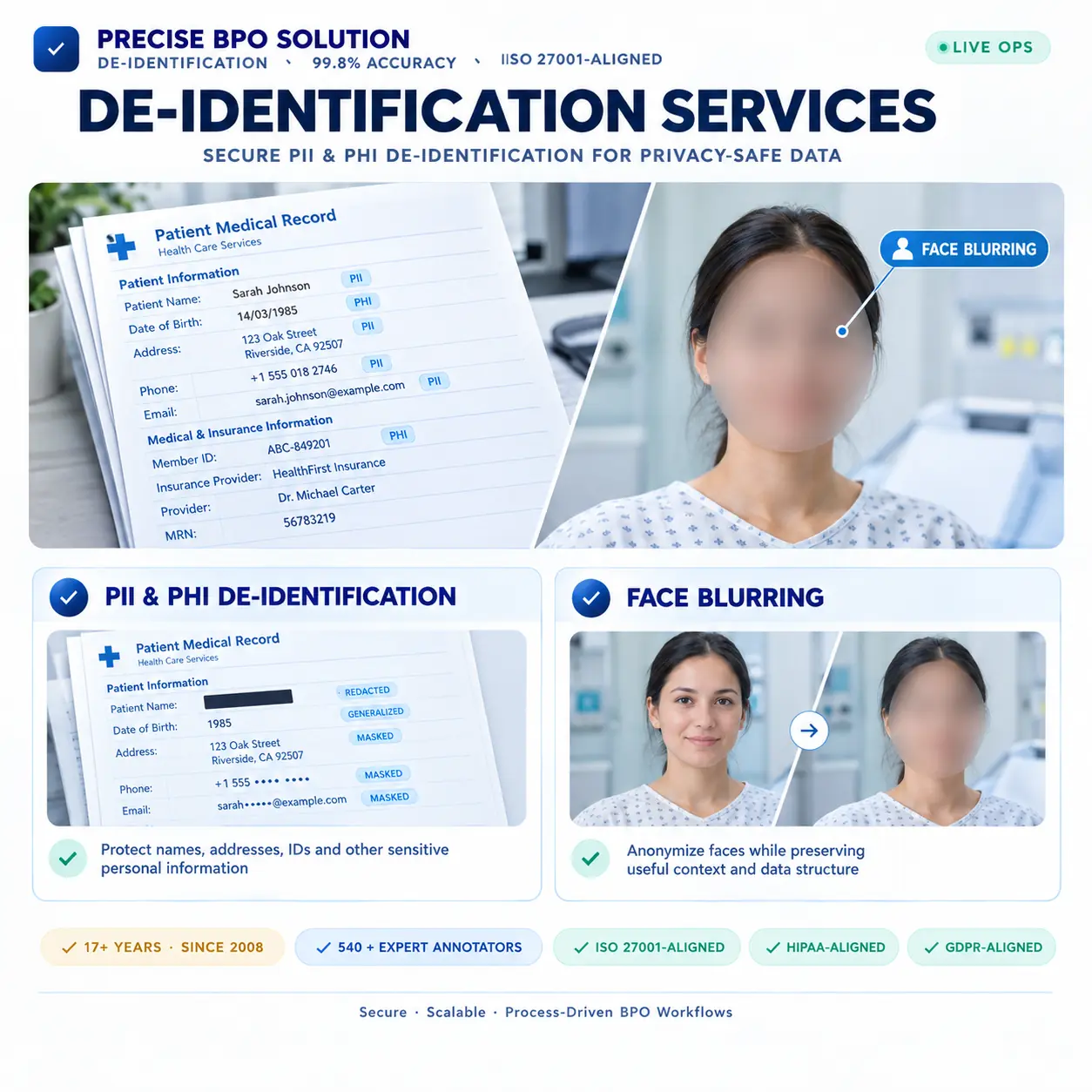
Enterprise-Grade Security & Data Compliance Alignment
🌍 Serving enterprises across US · UK · Canada · Australia · Europe · Middle East · APAC · LATAM
Data de-identification is the process of removing or masking personally identifiable information (PII) and protected health information (PHI) from images, video, text, and structured datasets to protect individual privacy while preserving the data's utility for artificial intelligence (AI) and machine learning (ML) training and analytics. It allows AI researchers and enterprise teams to work with real-world data through GDPR-Aligned and HIPAA-Aligned workflows — supporting the strict privacy regulations that govern personal data and protected health information.
As part of Precise BPO's full data labeling services portfolio, de-identification combines strategic masking, blurring, redaction, and tokenization techniques that remove sensitive identifiers from structured and unstructured data while preserving the features necessary for training AI algorithms. It is widely used across healthcare imaging, automotive LiDAR and camera datasets, financial records, and smart city surveillance feeds.
A de-identification workflow typically combines automated detection models with controlled manual review — every face, license plate, name, date of birth, medical record number, or account identifier is located and classified as either a direct identifier or a quasi-identifier, tagged by PII or PHI type, and masked according to client-defined rules. New to the space? Our guide to what data labeling is covers the broader context behind privacy-preserving AI datasets.
Precise BPO India delivers advanced de-identification services as part of its full data labeling portfolio, with a 17-year track record since 2008, 540+ trained specialists, and 810M+ overall images processed — including 20M+ images specifically de-identified for PII removal across enterprise AI projects.
We help SBU, MBU, and Enterprise clients secure sensitive data while maintaining AI-readiness for high-volume machine learning datasets. Our workflows provide complete data anonymization and masking for images, videos, text, and multi-modal datasets, following ISO 27001-Aligned, HIPAA-Aligned, and GDPR-Aligned practices to ensure privacy-preserving AI and safe data handling at every stage. New to the space? Our primer on how data labeling works walks through the fundamentals.
Multi-layer QA, automated validation, and senior QC reviews maintain high accuracy and consistency across SBU, MBU, and enterprise projects. Serving clients across US, UK, Canada, Australia, Europe, Middle East, APAC, and LATAM, we handle datasets from healthcare imaging and financial records to autonomous vehicle LiDAR annotation and smart city surveillance. Our bounding box labeling specialists and radiology & DICOM annotation teams often work alongside this de-identification practice for combined detection-and-privacy AI pipelines, while teams handling sensitive media can pair this service with our explicit content annotation for identity-safe trust-and-safety pipelines. Our online data entry and data conversion services support teams migrating legacy datasets that also need PII removal.
De-identification removes or masks PII/PHI across images, video, documents, and structured data so AI teams can train, share, and analyze datasets without exposing personal information — from hospital records to autonomous vehicle footage. Pair it with our object detection annotation for detection-and-privacy pipelines. Browse our full data labeling services to see the complete scope of annotation types we support across these industries.
Healthcare data de-identification covering PHI redaction across EHRs, DICOM medical imaging, and clinical notes — names, MRNs, and dates removed or masked to support HIPAA-Aligned research, clinical trial data sharing, AI model training, and secondary use of patient data. Teams digitizing the underlying paperwork often pair this with our medical claim data entry service.
Face and license-plate blurring across dashcam, LiDAR, and CCTV footage — consistent, frame-accurate redaction that keeps AV and smart-city perception data usable without exposing bystanders. Fleet operators digitizing trip logs alongside this often use our vehicle data entry services.
Account numbers, SSNs, credit card details, and KYC information redacted from statements, loan documents, and transaction logs — enabling safe data sharing for fraud modeling, audits, and analytics teams. Often delivered alongside our financial data entry services for the same document set.
Claims files, contracts, and case records redacted of personal identifiers — supporting e-discovery, compliance review, and safe document sharing across legal and insurance workflows. Pairs naturally with our legal document data entry service for firms digitizing case files at volume.
Customer order, loyalty, and support records anonymized for analytics, personalization model training, and safe sharing with third-party AI vendors.
Resumes, background checks, and employee files de-identified for workforce analytics, model training, and compliant cross-border data transfers.
Census, permit, and case-management data redacted for public release, FOIA requests, and inter-agency analytics without compromising citizen privacy.
Study datasets de-identified to IRB and HIPAA Safe Harbor standards, enabling open data sharing and reproducible research without re-identification risk.
Call transcripts and voice recordings scrubbed of names, numbers, and account details — voice anonymization and PII redaction for QA, sentiment analysis, and conversational AI training.
Privacy technique selection directly impacts re-identification risk, data utility, and compliance posture. This comparison helps data and privacy teams choose the right approach for their dataset and use case.
| Criteria | De-identification | Data Masking | Synthetic Data |
|---|---|---|---|
| Method | Redacts, blurs, or removes direct identifiers | Replaces identifiers with reversible tokens | Generates artificial data mimicking real patterns |
| Best for | Images, video, documents & PHI/PII removal for AI training | Structured databases needing reversible links in dev/test | Training data with zero real PII exposure |
| Re-identification Risk | Very Low | Low–Medium (reversible by design) | Near Zero |
| Processing Speed | Fast | Fastest | Slowest — requires model training |
| Data Utility Retained | High — visual & contextual fidelity preserved | High — original structure preserved | Medium — statistical patterns only |
| Reversibility | Irreversible by design | Reversible with secure key | No mapping to real records |
| Common Use Cases | Healthcare imaging, AV footage, surveillance, documents | Dev/test database environments, internal analytics | ML model pretraining, privacy-safe research |
| Precise BPO Service | This page — De-identification | Ask about masking workflows → | Ask about synthetic data pilots → |
Data masking is sometimes called pseudonymization when tokens can be mapped back to source records under controlled access — distinct from true de-identification, which severs that link entirely. Privacy teams handling structured datasets occasionally layer k-anonymity grouping or differential privacy noise on top of any of these three approaches for an extra margin of statistical protection.
Not sure which privacy technique fits your project? Talk to our data privacy specialists — we'll recommend the right approach based on your data types, compliance needs, and downstream AI use case.
Expert PII/PHI redaction and anonymization service — covering face and license-plate blurring, document redaction, DICOM scrubbing, and structured-data masking — supporting multi-modal, high-precision, and context-aware privacy protection across enterprise AI pipelines.
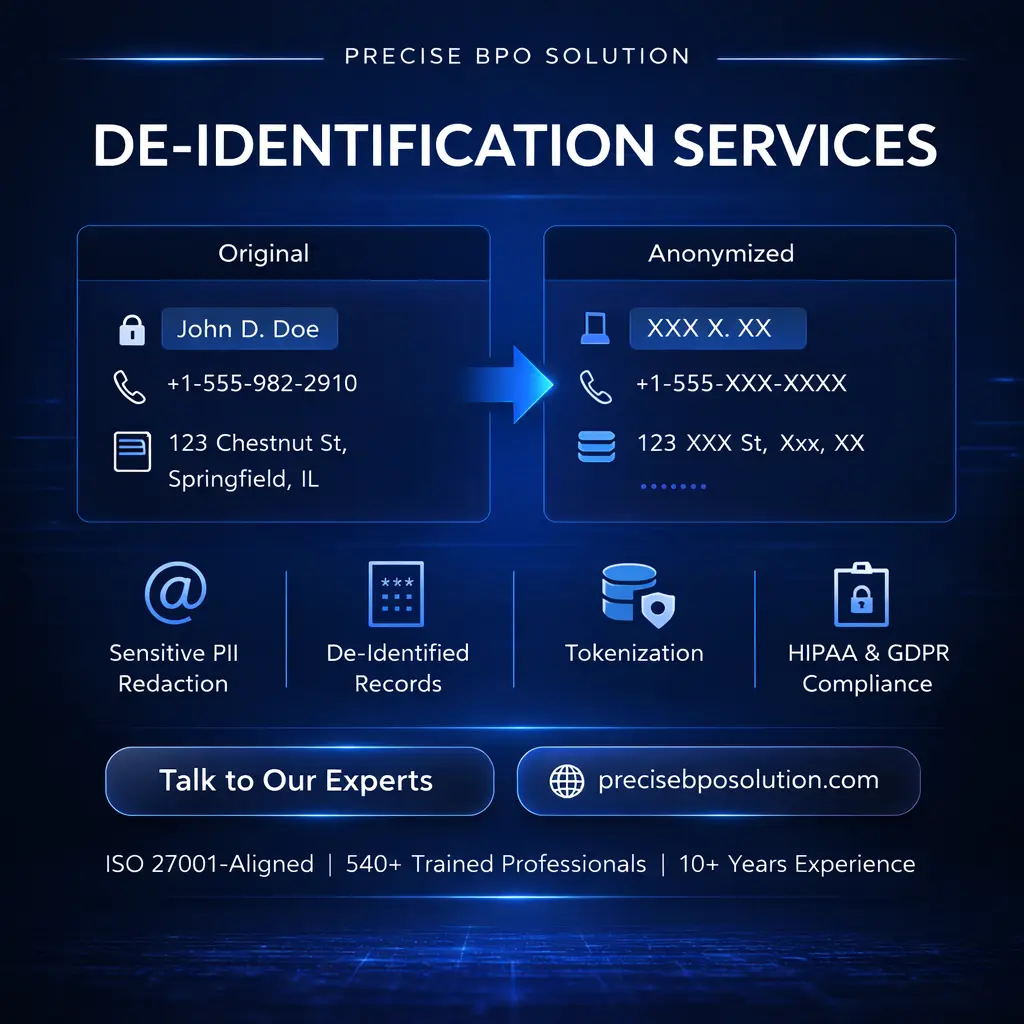
Platform-agnostic and format-flexible de-identification solutions — we work within your existing privacy stack or recommend the right tools for your project. No lock-in, no re-tooling overhead.
End-to-end workflow covering risk assessment, PII/PHI redaction, multi-stage privacy QC, review steps, and final delivery — optimized for speed and 99.8% accuracy. Our annotation governance framework defines how each step is standardized and audited across every client project.
Define PII/PHI categories, redaction rules, and re-identification risk thresholds with your privacy and AI teams before any processing begins.
Images, video, documents, and records are received via encrypted transfer, normalized to standard formats, and structured into batches under NDA-bound, ISO 27001-Aligned infrastructure.
540+ trained specialists apply redaction, blurring, and masking across image, video, text, and document datasets, ensuring consistent coverage and contextual accuracy.
Re-identification risk scoring, coverage audits, automated QC sampling, and expert reviewer sign-off maintain a consistent 99.8% PII/PHI detection accuracy benchmark across all batches.
Integrate feedback, refine redaction rules, update identifier lists, and adjust sampling or risk thresholds — iterating until the dataset fully meets your compliance and pipeline requirements.
Deliver de-identified datasets in DICOM, redacted PDF, JSON, CSV, video, or custom formats — with QC logs, audit trails, and a dedicated account manager for ongoing volumes.
Practical outcomes showing how our PHI redaction services, PII anonymization, and privacy-preserving workflows improve compliance posture, reduce re-identification risk, and support faster AI deployment across regulated industries.
Precise BPO is an India-based de-identification company with 17+ years of experience since 2008 — delivering HIPAA-Aligned, GDPR-Aligned PHI and PII redaction and data anonymization services to healthcare, finance, automotive, and AI teams worldwide. Our data labeling services portfolio covers 15+ annotation types, and our deep privacy compliance expertise makes us a single offshore partner for both structured data and computer vision privacy pipelines. Trusted across US, UK, Canada, Australia, Europe, Middle East, APAC & LATAM.
Start Your De-identification Pilot →Deep institutional knowledge of PII/PHI redaction workflows and privacy-preserving annotation built over nearly two decades.
Trained, dedicated de-identification teams — 540+ specialists — delivering enterprise PHI redaction and large-scale anonymization without compromise on quality.
Secure access control, NDA-bound workflows, audit trails, and automated security monitoring protecting every dataset at every stage.
Multi-stage QC combining automated PII detection, manual reviewer audits, sampling, and expert validation for consistent de-identification quality.
Enterprise-quality de-identification at significantly lower cost than in-house or US/EU-based teams — no hidden fees, full audit transparency.
We process images, video, DICOM, PDFs, and structured data within your existing tools or preferred pipeline — no platform switching required.

Every de-identified record passes three mandatory quality gates before client delivery. This multi-tier QA system catches different error types — missed PII, incomplete redaction, and format integrity — so privacy risks never reach your downstream AI pipeline.
Human-driven first pass by the de-identification specialist, then cross-checked by a senior peer. Catches missed PII, partial redactions, and guideline deviations before any automated scanning. Our annotation governance framework defines how these privacy standards are enforced across every project.
Algorithm-driven validation layer that re-scans every record for residual PII/PHI, checks for redaction consistency, and flags statistical outliers across the batch before human expert review.
QA Lead conducts random sampling plus full-batch review on high-stakes healthcare and financial projects. Client feedback loops are built in — corrections are applied and re-verified before final encrypted delivery.
For privacy leads, data engineering teams, and procurement officers justifying de-identification outsourcing to stakeholders — with transparent, honest numbers. Teams needing both de-identification and annotation can combine PHI redaction with our object-detection labeling team under one NDA and compliance framework.
| Criteria | In-House Team | Generic BPO | Precise BPO ★ Recommended |
|---|---|---|---|
| De-identification Accuracy | 85–92% (fatigue, limited QC) | 92–95% (inconsistent PHI coverage) | ✔ 99.8% — 3-tier multi-stage QC |
| Setup Time | 6–10 weeks (hire, train, tool) | 3–5 weeks | ✔ Live in 24–48 hours |
| Scalability for Surge Volumes | ❌ Fixed headcount, slow ramp | ⚠ Limited, delays common | ✔ 540+ team, instant scale |
| Cost vs In-House | Baseline (salary + infra) | 25–35% savings | ✔ Up to 60% cost savings |
| HIPAA-Aligned / GDPR-Aligned | ❌ Rarely formally verified | ⚠ Claimed, often unverified | ✔ ISO 27001-Aligned, HIPAA-Aligned & GDPR-Aligned |
| Multi-Modal De-identification | ⚠ Usually siloed by media type | ⚠ Varies by vendor | ✔ Images, video, DICOM, PDFs, structured data |
| Audit Trail & Reporting | ⚠ Manual, inconsistent | ⚠ Often limited or unavailable | ✔ Full redaction logs, per-record audit trail |
| Free Trial / Pilot | ❌ Not applicable | ❌ Rarely offered | ✔ Free pilot batch, no commitment |
Transparent de-identification pricing — no platform fees, no lock-in. Choose the model that fits your data volume, compliance requirements, and budget. All engagements include a free pilot batch before any commitment.
Pay per de-identified image or video frame. Ideal for defined datasets, one-off anonymization projects, or AV and surveillance pipelines with a predictable per-unit cost.
Priced per document page or record. Purpose-built for financial, legal, and healthcare document redaction where page count is the natural unit of work.
Hourly model for high-complexity de-identification — mixed entity types, structured data, nested PHI, or projects where per-record pricing doesn't reflect actual effort.
A dedicated de-identification team at fixed monthly capacity. Best for enterprises and AI labs with continuous PHI/PII redaction needs, active learning pipelines, or ongoing regulatory compliance workflows.
As a de-identification services provider, our India-based delivery hub runs 24/7 across time zones — delivering HIPAA-Aligned, GDPR-Aligned, and ISO 27001-Aligned de-identification to healthcare, finance, automotive, and AI teams across US, UK, EU, APAC, Middle East, Australia, Canada, and LATAM.
Healthcare, finance, automotive, and AI teams worldwide trust Precise BPO India for consistent, scalable, and accurate data de-identification at enterprise scale.
★★★★★"Precise BPO handles our entire DICOM de-identification pipeline for radiology AI. Their PHI removal accuracy is consistently above 99.8%, and the team scales instantly for large imaging batches."
★★★★★"We engaged Precise BPO to de-identify 50M+ dashcam frames for GDPR-Aligned processing before our EU model training. The turnaround, accuracy, and secure handling were exceptional."
★★★★★"Our financial document redaction pipeline improved dramatically after switching to Precise BPO. 540+ trained specialists, comprehensive PII coverage, and an audit trail that satisfies our compliance team every time."
★★★★★"Exceptional white-label de-identification partner. They operate seamlessly within our HIPAA-Aligned platform, meet tight SLAs, and the accuracy is simply the best we've seen from any outsourced privacy vendor."
★★★★★"We needed 5M+ patient records de-identified for clinical AI research. Precise BPO scaled their team rapidly, applied HIPAA Safe Harbor standards, and delivered flawless audit logs — on schedule."
★★★★★"Precise BPO India is our long-term partner for smart city surveillance anonymization. Their cost efficiency, ISO 27001-Aligned security, and consistent 99.8% de-identification accuracy make them irreplaceable."
Clear answers on de-identification scope, PII/PHI entity types, QA processes, compliance frameworks, output formats, large-scale project management, and pricing for de-identification outsourcing.
Data de-identification is the process of removing or masking personally identifiable information (PII) and protected health information (PHI) from datasets so individuals cannot be identified. Entity types covered include: faces, license plates, names, dates of birth, addresses, phone numbers, email addresses, National ID numbers, account numbers, medical record numbers, biometric markers, vehicle identification, and any other client-defined identifiers. This applies across images, video frames, DICOM files, PDFs, and structured data formats.
Faces and license plates are detected using a combination of automated detection models and manual specialist review. Each identified region is masked using the client's preferred method — pixelation, solid fill, blur, or black-box redaction. Edge cases such as partially visible faces, occlusion, low-light frames, and non-standard plate formats are handled by trained specialists with project-specific guidelines. All applied redactions are logged per record for audit traceability.
Our workflows are HIPAA-Aligned and designed to support both HIPAA Safe Harbor (18 PHI identifiers removed) and Expert Determination methods depending on project requirements. We operate under ISO 27001-Aligned security controls, require NDAs from all personnel with project access, implement role-based access controls, and maintain full audit trails for every record processed. We also support GDPR-Aligned de-identification for European datasets, and region-specific compliance for Canadian (PIPEDA-conscious) and APAC regulations.
We support de-identification across a wide range of media types and formats: images (JPEG, PNG, TIFF, BMP), video (MP4, AVI, MOV, frame sequences), medical imaging (DICOM — both pixel and metadata tag scrubbing), documents (PDF, DOCX, scanned records), structured data (CSV, JSON, XML, EHR exports), and audio/transcripts. DICOM de-identification includes both pixel-layer anonymization and removal of embedded PHI tags from the metadata fields per DICOM PS3.15 standards.
Accuracy is measured through our 3-tier QA pipeline: Tier 1 is specialist self-check and peer review targeting 95%+ redaction completeness. Tier 2 runs automated entity re-detection on the redacted output to surface any residual PII/PHI — flagging missed instances for human correction. Tier 3 is a QA Lead expert audit with random sampling (10–20% per batch, 100% for healthcare-critical projects) and a client acceptance review of sample records before full batch delivery. Final delivery accuracy is contractually maintained at 99.8%.
Large or continuous de-identification projects are managed through structured task allocation, batch-based processing with defined QA checkpoints, and dedicated project teams for each client engagement. For ongoing pipelines — such as live EHR systems, recurring AV datasets, or active learning loops — monthly retainer engagements provide a fixed-capacity dedicated team operating within your SLAs. All batches include redaction logs, entity-type breakdowns, and delivery confirmations with full traceability.
All data is transferred over encrypted, client-approved channels (SFTP, secure cloud storage, VPN access). Specialists access datasets through permission-scoped, role-based systems — no local storage or downloading to personal devices is permitted. Automated security monitoring runs continuously across all project environments. Upon project completion, all source data is securely deleted per client instructions and confirmed with a destruction certificate. These controls are aligned with ISO 27001-Aligned, HIPAA-Aligned, and GDPR-Aligned security requirements. See full details in our guide to annotation governance & security controls.
De-identification pricing depends on media type, entity density, volume, and review depth. Common models include per-image or per-frame (AV and surveillance), per-record or per-page (documents and medical records), hourly (complex multi-modal or mixed-entity datasets), and monthly retainer (ongoing pipelines). Our India-based team typically offers 50–60% savings versus equivalent US, UK, or EU de-identification providers. All engagements include a free pilot batch before commitment. Request a tailored de-identification quote based on your dataset type and volume.
Yes — this is one of the most common configurations for healthcare AI and autonomous vehicle teams. De-identification runs as a preprocessing step before annotation (e.g., DICOM face blurring before radiology region-of-interest labeling, or dashcam plate removal before bounding box labeling). Both services are delivered under one NDA, one SLA, and one compliance framework. See how we combine these in our bounding-box annotation service and full data labeling services pages.
Automated de-identification tools typically achieve 80–88% accuracy — missing edge cases, unusual PII formats, and context-dependent identifiers. Our human-in-the-loop approach combines automated detection with trained specialist review and 3-tier QA, reaching 99.8% accuracy. We handle low-contrast images, unusual entity types, handwritten records, partially visible identifiers, and multi-language documents that pure automation misses. Every project begins with a free pilot so you can verify quality against your specific dataset before committing to full-scale processing.
Practical guides on PHI/PII redaction, data anonymization for AI, compliance frameworks, and privacy-preserving data pipeline management — for privacy leads, data engineers, and ML teams.
Work with experienced India-based teams delivering accurate PHI/PII redaction and privacy-preserving AI datasets, supported by 540+ trained specialists. Our complete annotation services lineup and data entry services are available under one engagement. Request a free pilot or project quote.
Get a response within 24 hours — no commitment required.
Our de-identification specialists will review your requirements and respond within 24 hours. We look forward to securing your AI training datasets.