What Is Data Labeling? Enterprise Guide
Learn what data labeling is, its types, AI use cases, quality standards and how enterprises scale annotation for ML.
High-volume fashion image annotation for visual search, AR/VR try-on, outfit recommendation, and catalog AI — with 17+ Years Since 2008, 540+ trained annotators, 48M+ fashion images processed. ISO 27001-Aligned, HIPAA-Aligned & GDPR-Aligned workflows for global enterprises.
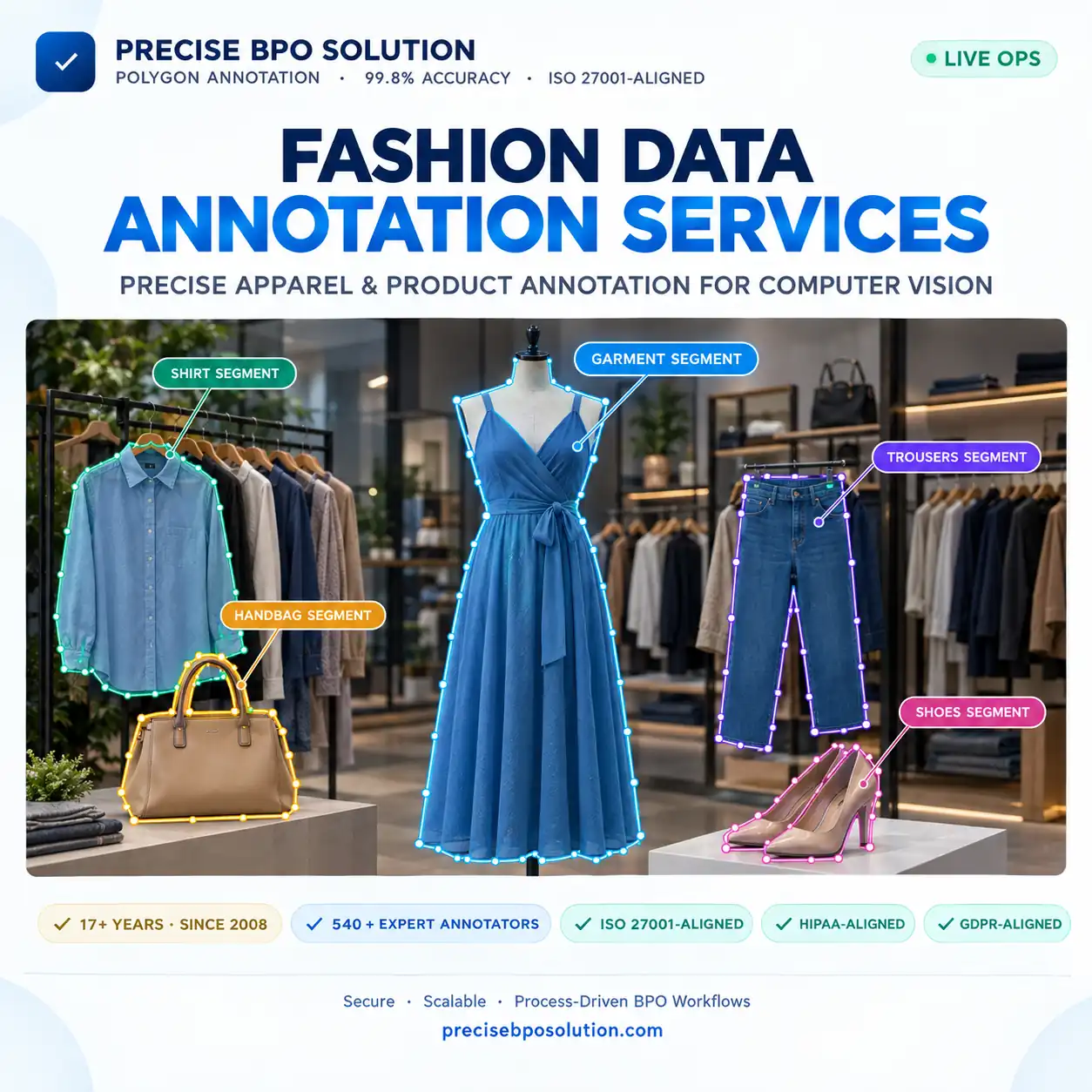
Fashion image annotation — also called garment annotation or clothing annotation — is the process of labeling and structuring visual product data — garments, footwear, accessories, and their attributes — so AI models can understand, classify, and retrieve fashion items accurately. Annotators apply bounding boxes, polygons, semantic masks, keypoints, and attribute tags to images, giving AI systems the labeled ground truth they need to learn visual patterns, product hierarchies, and garment characteristics.
It is the foundational technique behind visual search, outfit recommendation, AR/VR virtual try-on, automated catalog management, and fashion AI use cases across e-commerce and retail. Unlike generic object detection, fashion annotation requires domain expertise — understanding garment construction, fashion taxonomy, fabric behavior, and brand logic — to produce datasets that train accurate, commercially useful models.
Fashion annotation outputs are structured as COCO JSON, XML, CSV, or custom schemas — with attribute labels covering category, color, pattern, silhouette, material, fit, neckline, sleeve type, and 50+ additional fashion-specific fields — designed to integrate directly into AI training pipelines, catalog platforms, and recommendation engines.
Since 2008, Precise BPO has delivered fashion image annotation services supporting AI-driven visual search, AR/VR try-on experiences, outfit recommendation engines, catalog enrichment, and retail intelligence platforms — all from our Pune, India delivery centre operating 24/7 across global time zones. As a trusted fashion annotation service provider in India, we build every dataset to your exact model specification and taxonomy.
Our annotators specialize in fashion-domain labeling — applying bounding boxes, polygon segmentation, landmark keypoints, and detailed attribute tagging for color, pattern, texture, silhouette, neckline, sleeve type, fit, and length. We handle studio images, flat lays, lifestyle shots, model-based catalog visuals, and on-body photography — adapting to your annotation platform and output schema without switching costs.
For e-commerce platforms requiring high-volume SKU annotation for product discovery and catalog automation, we deliver pixel-level garment labels at scale — covering apparel tops, bottoms, dresses, footwear, jewelry, handbags, and accessories across 10K to 10M+ image volumes. Our India-based fashion annotation outsourcing model lets retail AI teams ramp from pilot to production without building in-house labeling infrastructure, reducing per-image costs by 50–60% against US or UK equivalents. Every delivered batch is production-grade AI training data ready to feed directly into your visual search or recommendation pipeline.
Global fashion tech companies, luxury brands, and e-commerce aggregators trust us for accurate fashion dataset labeling with consistent taxonomy alignment across seasonal collections, new catalog launches, and multi-region product databases. Whether your team needs ongoing image annotation outsourcing to India for a long-term fashion AI programme, or a burst-capacity partner for a time-bound seasonal upload, Precise BPO integrates directly into your existing workflow — no tool migration, no ramp-up friction, no minimum commitment. Teams that also need structured online data entry services or data conversion services alongside their annotation work can source all three under one NDA and compliance framework.
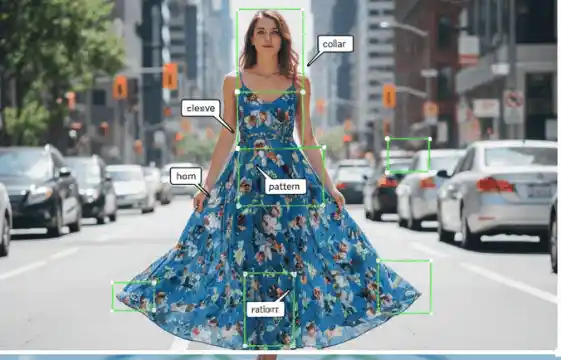
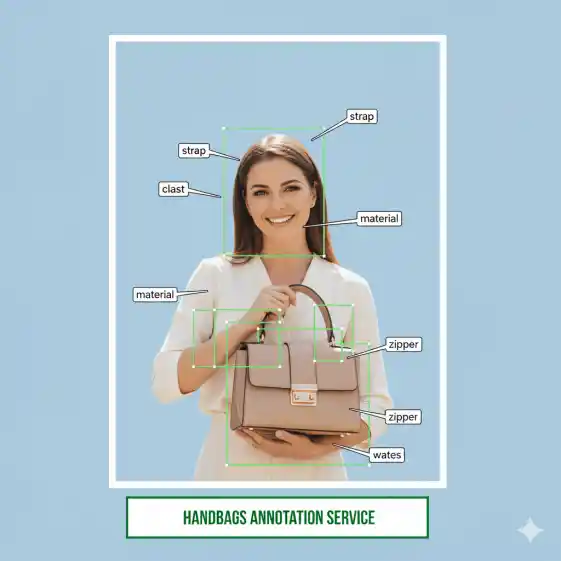
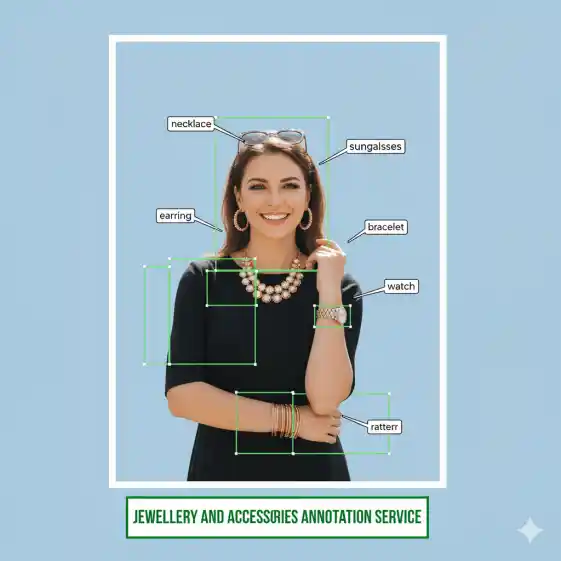
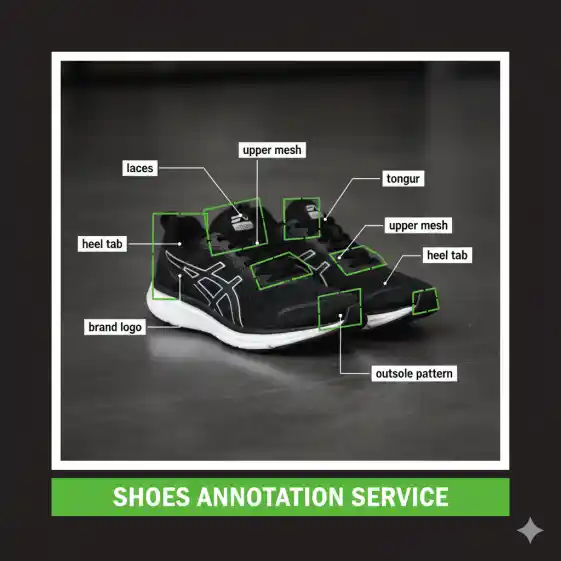
Fashion annotation datasets power visual search, recommendation engines, AR/VR platforms, catalog automation, and brand intelligence across the US, UK, EU, and APAC — enabling scalable AI systems that rely on precise apparel and attribute labeling.
We enhance product discovery and visual search accuracy through structured tagging of apparel, footwear, accessories, and style attributes to improve conversions and catalog quality across global fashion e-commerce platforms processing millions of SKUs.
We annotate datasets for virtual try-on, style matching, outfit generation, trend analysis, and AI fashion assistants using detailed tagging, polygon segmentation, and landmark keypoints — powering next-generation fashion discovery apps.
Our annotation supports defect detection, material classification, stitching pattern recognition, and quality control automation in manufacturing workflows — enabling AI-driven production intelligence and fabric inspection systems for the fashion industry.
We deliver pixel-level annotation for premium collections, including fabrics, trims, embellishments, textures, and brand logos with high precision — supporting luxury AI and brand protection platforms for global designer houses.
Accurate category mapping and taxonomy alignment ensure consistent product listings across sellers and platforms — improving search relevance, reducing catalog errors, and enabling automated attribute enrichment at marketplace scale. Sellers onboarding new SKUs often pair this with our product data entry services to keep listings, pricing, and attributes in sync across every channel.
We support AR try-ons, body landmarks, fit analysis, and real-time garment detection for immersive shopping and 3D fashion applications — annotating clothing regions and accessories with bounding boxes, polygons, and landmark points.
Annotation type selection directly impacts model accuracy and labeling cost. This comparison helps fashion AI and e-commerce ML teams choose the right approach based on garment complexity, use case, and pipeline requirements. For a deeper breakdown of common labeling errors and IoU benchmarks, see our bounding box annotation mistakes guide.
| Criteria | Bounding Box | Polygon / Keypoint | Semantic Segmentation |
|---|---|---|---|
| Shape Output | Rectangle enclosing the garment | Precise outline or body landmark points | Pixel-level mask per garment class |
| Best For | Product detection, catalog enrichment, attribute tagging at scale | AR/VR try-on, garment silhouette, body landmark fitting | Outfit parsing, fabric texture analysis, full scene understanding |
| Annotation Speed | Fastest — single drag per item | Moderate — point-by-point tracing | Slowest — pixel-level per class |
| Cost Efficiency | Highest — scales well at volume | Medium — higher effort per image | Lowest — intensive per image |
| Garment Precision | Object-level (includes background) | High — garment boundary + landmark | Pixel-perfect per garment |
| Attribute Tagging | Excellent — paired with bbox labels | Moderate — focus on geometry | Class-level tags only |
| Common Fashion Use Cases | Visual search, catalog AI, e-commerce recommendation, style classification | AR try-on, body-garment fitting, silhouette recognition, luxury labeling | Outfit parsing, material detection, full-body scene analysis |
| Precise BPO Service | Bounding Box Annotation → | This page — Fashion Annotation | Semantic Segmentation → |
Not sure which annotation type fits your fashion AI project? Talk to our fashion annotation specialists — we'll recommend the right approach based on your product types, model architecture, and catalog requirements.
Comprehensive annotation for apparel, footwear, and accessories, including segmentation, attributes, landmarks, and taxonomy mapping for visual AI systems across all fashion categories and use cases.
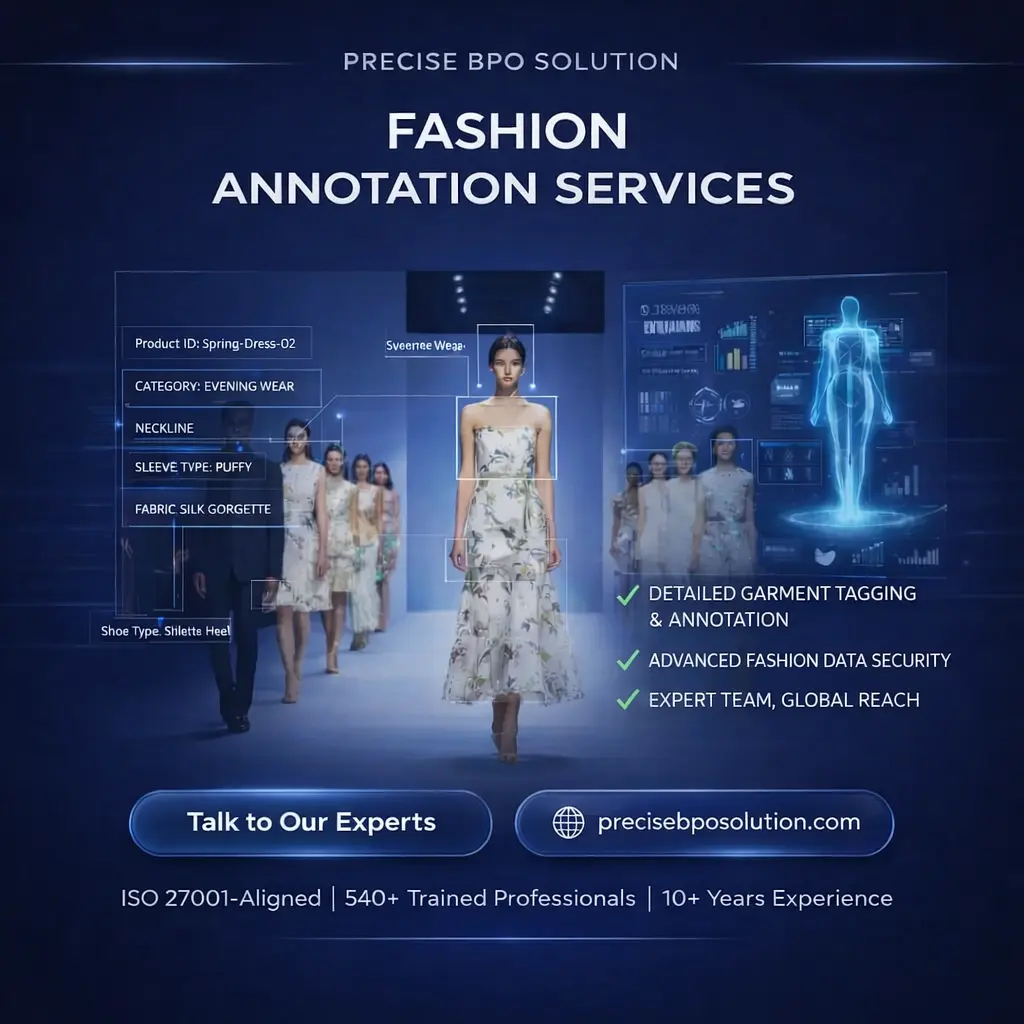
We work closely with your team to understand the attributes, taxonomy structure, annotation formats, and labeling expectations needed for your AI use case. This ensures annotations are aligned with your model goals, data standards, and intended outcomes — whether for visual search, outfit recommendation, or AR/VR try-on systems.
Your fashion imagery and catalog data is handled within controlled, access-restricted environments using ISO 27001-Aligned, HIPAA-Aligned, and GDPR-Aligned practices. Access is managed by role to ensure responsible handling while enabling smooth coordination across annotation teams — all annotators sign NDAs before any project access is granted.
Our fashion specialists perform precise annotation using bounding boxes, polygons, segmentation, and detailed attribute tagging. Each dataset undergoes multiple quality checks — peer review, taxonomy consistency validation, and expert audit — to maintain high accuracy, class consistency, and dependable training results.
Annotated outputs are delivered in JSON, COCO, XML, CSV, or connected directly to your preferred platforms including CVAT, Labelbox, SuperAnnotate, and V7. Our delivery model is built to scale efficiently as catalog volumes grow, seasonal collections expand, or dataset requirements evolve across your AI pipeline.
We continuously refine labeling guidelines, attribute definitions, and taxonomy consistency standards based on model feedback and performance insights. This maintains long-term dataset quality and alignment as your AI models, product range, and use cases evolve — ensuring your fashion datasets stay current and accurate.
Real-world applications of fashion image annotation supporting visual search, virtual try-on, catalog accuracy, recommendation engines, luxury labeling, and retail intelligence across global enterprise clients.
Platform-agnostic and format-flexible — we work within your existing fashion annotation tools and machine learning frameworks, or recommend the right stack for your project. Our annotators are trained across CVAT, Labelbox, SuperAnnotate, V7, and other major platforms. No lock-in, no re-tooling overhead.
Precise BPO is an India-based apparel and footwear annotation company with 17+ years of experience since 2008 — delivering accurate, scalable, and cost-efficient image labeling services to fashion brands, AI startups, and e-commerce teams worldwide. Teams that outsource to us get high-accuracy apparel tagging, attribute and taxonomy annotation, and visual search datasets — handled by 540+ in-house annotators. Trusted across US · UK · Canada · Australia · Europe · Middle East · APAC · LATAM.
Start Your Fashion Annotation Pilot →Deep institutional knowledge of fashion-specific annotation workflows — from basic bounding boxes to complex multi-attribute taxonomy labeling — built over nearly two decades.
Dedicated, trained annotation teams delivering precise fashion labels at enterprise scale — no crowdsourced workers, no quality compromise on any catalog or image volume.
Secure access control, NDA-bound workflows, and automated security monitoring ensure your sensitive catalog and imagery datasets stay protected end to end.
Multi-stage QC combining taxonomy validation, attribute consistency checks, peer review, and expert audit — ensuring dependable, production-ready fashion annotation on every batch.
India-based delivery at a fraction of in-house or Western BPO costs — with no hidden fees, no lock-in, and a free pilot batch before any commitment to full-scale annotation.
We annotate within your preferred tooling — CVAT, Labelbox, V7, SuperAnnotate — and deliver in COCO, YOLO, JSON, XML, or any client-defined schema for your AI pipeline.

Every apparel and footwear dataset passes three mandatory QA gates before client delivery. This multi-tier quality control system is how we sustain best-in-class fashion annotation accuracy — catching attribute inconsistencies, taxonomy misclassifications, and labeling errors before they compound downstream.
High accuracy fashion image labeling is not a default outcome — it is the result of disciplined process at every stage.
Human-driven first pass by the annotator, then cross-checked by a senior peer. Catches attribute placement errors, category mismatches, and guideline deviations before any automated scoring.
Automated and semi-automated taxonomy checks verify attribute completeness, class-value consistency, and edge-case handling against the project's labeling schema.
Final expert audit by senior quality lead using statistical sampling. Confirms end-to-end accuracy before batch release to client systems or delivery.
For AI leads, ML engineers, and procurement teams justifying outsourcing to stakeholders — a direct, honest comparison with transparent numbers for fashion image annotation projects.
| Criteria | In-House Team | Generic BPO | Precise BPO ★ Recommended |
|---|---|---|---|
| Annotation Accuracy | ✕82–90% — no fashion QC, taxonomy drift | ⚠88–93% — no domain taxonomy checks | ✓99.8% guaranteed — 3-tier fashion QA pipeline |
| Setup Time | ✕8–12 weeks — hire, train, tool, taxonomy | ⚠3–5 weeks | ✓Live in 24–48 hours |
| Scalability for Surge Volumes | ✕Fixed headcount, slow ramp | ⚠Limited, delays common | ✓540+ team, instant scale to 10M+ SKUs |
| Cost vs In-House | ✕Baseline — salary + infra + tools | ⚠25–35% savings | ✓Up to 60% cost savings |
| ISO 27001-Aligned Security | ✕Rarely formal | ⚠Claimed, unverified | ✓ISO 27001, HIPAA & GDPR Aligned |
| Fashion Domain Expertise | ⚠Varies — costly to build | ⚠Generic annotators, no taxonomy depth | ✓540+ fashion-trained annotators, 50+ attribute expertise |
| Attribute Tagging Depth | ⚠Limited coverage, inconsistent | ⚠Basic labels only | ✓50+ attributes — color, pattern, silhouette, fabric & more |
| Free Trial / Pilot | ✕Not applicable | ✕Rarely offered | ✓Free pilot batch, no commitment |
Transparent fashion annotation cost — no platform fees, no lock-in. Pricing is structured to fit your catalog volume and timeline, and all engagements include a free pilot batch before commitment.
Pay per annotated image. Ideal for defined catalog datasets, seasonal collection launches, or e-commerce teams building initial labeled product sets at a predictable per-unit cost.
Priced per attribute tag. Purpose-built for deep fashion labeling where multiple attributes — color, pattern, neckline, sleeve, fabric — are applied per item and each label carries specific value.
Hourly model for high-complexity annotation — polygon garment segmentation, body landmark fitting, brand logo mapping — where per-image pricing doesn't reflect actual annotation effort.
A dedicated fashion annotation team at fixed monthly capacity. Best for enterprises with continuous catalog updates, active learning pipelines, or seasonal collection annotation workflows running year-round.
Our India-based delivery hub runs 24/7 across time zones — covering US, UK, EU, APAC, Middle East, Australia, Canada, and LATAM with region-specific annotation standards and compliance protocols for global fashion & e-commerce clients.
Feedback from global fashion AI, e-commerce, and retail teams who have scaled their annotation workflows with Precise BPO.
Practical guides on fashion data labeling, visual search datasets, annotation vendor selection, and AI training data strategies — for e-commerce AI engineers, ML teams, and fashion tech leads.
Clear answers on annotation workflows, security controls, accuracy benchmarks, output formats, scalability, and global project execution for fashion AI and e-commerce teams.
Fashion image annotation services help structure visual product data so it can be used for search, recommendations, tagging, and catalog intelligence. By labeling garments, accessories, and attributes, businesses can improve product discovery, visual similarity matching, and dataset quality for AI-driven fashion, retail platforms, and analytics systems. See our guide to data labeling for broader context.
Annotation can be applied to apparel, footwear, accessories, jewelry, lifestyle images, and model-based photos. This includes studio images, flat lays, lifestyle shots, and catalog visuals. These datasets are commonly used for e-commerce catalogs, visual search tools, recommendation systems, and fashion analytics workflows. Teams that also need structured data alongside annotation work can explore our data entry outsourcing guide.
Fashion datasets can include labels for categories, colors, patterns, silhouettes, materials, sleeve types, necklines, lengths, and style features. Bounding boxes, polygons, landmarks, and attribute tags help define visual structure, enabling consistent classification and meaningful interpretation across AI models and retail systems.
Yes. Fashion annotation workflows are designed to support both small and very large datasets, including ongoing catalog updates and seasonal collections. Teams can handle thousands to millions of images while maintaining consistent labeling logic — suitable for long-term catalog growth and large-scale AI training needs at 10K to 10M+ SKU volumes.
Consistency is maintained by applying shared labeling standards across all datasets so similar items are treated the same way. This helps produce uniform annotations that support reliable search, analytics, and model training outcomes. See our annotation governance framework for how we enforce these standards on every project.
Annotated fashion data can be delivered in JSON, XML, CSV, COCO, or custom schemas. These formats are compatible with AI training pipelines, analytics systems, and e-commerce platforms, allowing easy ingestion without additional restructuring or transformation — compatible with PyTorch, TensorFlow, YOLO, and major e-commerce catalog platforms.
Engagements can support short-term projects, recurring workloads, or long-term annotation programs. Teams can scale based on image volume, category expansion, or seasonal demand. This flexibility allows brands and platforms to manage workloads predictably while maintaining consistent dataset quality over time — with per-image, per-attribute, or monthly retainer pricing available. See our data labeling pricing guide or request a custom fashion annotation quote.
Yes. Our workflows are ISO 27001-Aligned, HIPAA-Aligned, and GDPR-Aligned to ensure maximum data security for global fashion AI and e-commerce partners. All annotators sign NDAs before any project access, roles are permission-scoped, and automated security audits run continuously across all project environments — protecting sensitive catalog datasets end to end.
Work with experienced India-based teams delivering accurate fashion image annotation for visual search, AR/VR try-on, catalog AI, and e-commerce intelligence — supported by 540+ trained annotators. Outsourcing to us typically saves 50–60% versus in-house US or UK teams without compromising quality. Our full data labeling services and online data entry support are available under one engagement. Meet the Precise BPO team or request a free pilot or project quote below.
Get a response within 24 hours — no commitment required.
Your fashion annotation enquiry has been received. A member of our team will respond within 24 hours to discuss your project and arrange a free pilot batch.