What Is Data Labeling?
An introduction to data labeling: what it is, the main annotation types and where each is used.
Precise BPO Solution provides image meta tagging services for teams that need more than object labels. Our trained in-house annotators write detailed captions, classify scenes, record object attributes, and capture how objects relate to each other and to their surroundings. The result is delivered as structured metadata in the schema you define, and every record is checked by a person against your guidelines. We have processed 810M+ images across our annotation services since 2017 and work with clients in 27+ countries.
How We Work
Figures above are company-level totals across all Precise BPO annotation and data services. They are not meta tagging volumes alone.
A bounding box tells a model where a car is. Meta tagging tells it that the car is a white sedan, parked on a dry road beside a construction site, with a cyclist passing on its left. That layer of description, classification, attributes, relationships and context is what captioning, retrieval, search and scene-understanding models learn from, and it depends on human judgment about what is actually visible in the frame.
Precise BPO Solution delivers this as an outsourced, human-led service. Our annotators work to your taxonomy and guidelines, or help you write them, record the metadata image by image, and pass each batch through review before delivery in JSON, CSV, XML, Excel or another format we agree with you. The 810M+ images and 390M+ objects above are company-level totals across all our annotation work, not meta tagging alone, but the same trained teams and review discipline apply here. You can read more about how our teams work.
This page covers descriptive and contextual image metadata. For geometric annotation such as boxes, polygons and landmarks, see our data labeling services. Meta tagging is often added on top of those labels, and it can also be delivered on its own.
Marks where objects are, using boxes, polygons or landmarks.
Records what the image shows: description, scene, attributes, relationships and context.
Each category can be ordered on its own or combined into one record per image. The examples shown are typical outputs; your schema decides the fields, wording and level of detail.
Annotators describe the whole scene in complete sentences: who or what is present, what they are doing, how they interact and what surrounds them. A generic label such as "car" or "street" becomes a description that a captioning or retrieval model can learn from. Caption length, tone and vocabulary follow your guidelines, whether you need one factual sentence or a fuller paragraph covering secondary detail.
Each image is classified by setting and conditions: indoor or outdoor, urban, rural or natural, industrial or commercial, plus weather, lighting and time of day. Categories can be single-label or multi-level (for example outdoor, natural, mountain), and we apply your taxonomy with decision rules for borderline images so that labels stay comparable across thousands of files.
For every object that matters to your use case, annotators record visible characteristics: category, colour, shape, size, material, texture, condition and any task-specific attribute. The attribute list is yours to define. A retail catalogue needs different fields from an agricultural survey, so we configure the taxonomy to the project instead of forcing a fixed set.
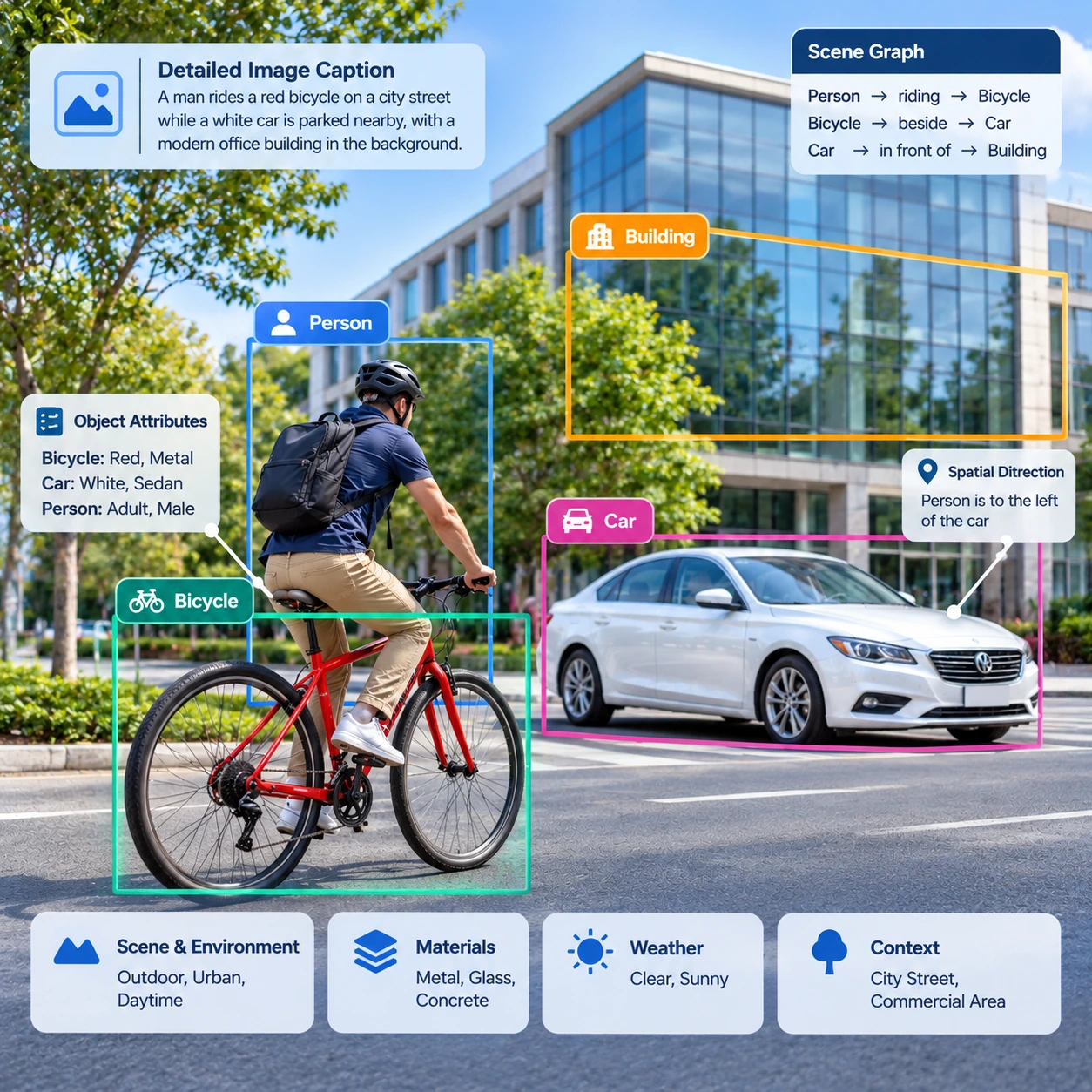
Relationship annotation records how objects and subjects relate: a person riding a bicycle, a person holding a tool, a car parked in front of a building, an animal standing near a tree. This is what separates a list of detected things from an understanding of what is happening in the image, and it is the layer that models trained only on plain object labels tend to lack.
Annotators record where objects sit relative to each other: left or right, above or below, in front of or behind, near or far, inside or outside, foreground or background, overlapping or adjacent. These are captured as structured labels from a controlled vocabulary, with a written rule for the reference point (the viewer's left or the subject's left) so that the same layout always gets the same label.
A scene graph organises an image into entities, their attributes and the relationships between them, so that it can be read by a machine and not only by a person. We build graph-style annotation as subject, predicate, object records tied to object IDs, ready to load into a scene-understanding, visual question answering or graph-based pipeline. A worked example appears in the next section.
Visible materials and surface qualities are tagged per object or per region: wood, metal, glass, concrete, fabric, plastic, polished or unpolished, smooth or rough. This metadata matters wherever appearance carries information, such as retail catalogues, industrial imagery and recognition datasets in which similar-looking objects are made of different things.
Context annotation records the conditions around the main subjects: site type, terrain, ground condition, weather, vegetation, nearby structures and infrastructure. The same machine in a warehouse, on a construction site and in a field is a different data point. Context tags let you filter, balance and evaluate a dataset by those conditions instead of discovering the gaps after training.
The example below shows how the categories above come together for a single image: a scene graph for relationships, and a machine-readable record for your pipeline. It is an illustration of structure, not a client deliverable.
Boxes are entities with their attributes; labelled arrows are relationships. Each entity carries an ID, so the same graph can be exported as subject, predicate, object triples.
| Level | What Is Recorded | Typical Fields |
|---|---|---|
| Image level | The whole image | Caption, scene, weather, lighting |
| Object level | Each object that matters | Category, colour, material, condition |
| Relationship level | How objects relate | riding, holding, beside, on |
| Spatial level | Relative position | left of, behind, foreground |
| Context level | Surrounding conditions | Site type, terrain, infrastructure |
Image-level and object-level fields sit in the same record and are linked by object ID, so downstream systems can query either level without re-matching files.
{
  "image_id": "IMG_000417",
  "caption": "A person in a helmet rides a red bicycle along a paved road past a parked white car, with a commercial building behind.",
  "scene": { "setting": "outdoor", "environment": "urban", "weather": "clear", "lighting": "daytime" },
  "objects": [
    { "id": "o1", "category": "person",   "attributes": { "age_group": "adult", "helmet": true } },
    { "id": "o2", "category": "bicycle",  "attributes": { "color": "red", "material": "metal", "state": "in motion" } },
    { "id": "o3", "category": "car",      "attributes": { "color": "white", "state": "parked" } },
    { "id": "o4", "category": "road",     "attributes": { "surface": "asphalt", "condition": "dry" } },
    { "id": "o5", "category": "building", "attributes": { "type": "commercial" } }
  ],
  "relationships": [
    { "subject": "o1", "predicate": "riding", "object": "o2" },
    { "subject": "o2", "predicate": "beside", "object": "o3" },
    { "subject": "o3", "predicate": "on",     "object": "o4" }
  ],
  "spatial": [
    { "subject": "o2", "relation": "foreground" },
    { "subject": "o5", "relation": "background" }
  ],
  "context": ["commercial district", "paved road"]
}
Field names, vocabularies and structure are defined by your schema. The same content can be delivered as CSV, XML or Excel.
Structure and file format are aligned to how your team or machine learning pipeline will read the data, subject to project requirements.
Most image metadata projects do not fit a fixed template. We adapt the annotation to the fields, hierarchy and rules your downstream use needs.
We turn your use case into a field list: which attributes, which allowed values, which fields are mandatory. If you already have a schema we work to it. If you have only a goal, we propose a schema on a small sample and refine it with you before volume work begins.
Hierarchical labels, such as outdoor, urban, street, are applied from your taxonomy, with written decision rules for edge cases so that similar images receive the same label whoever annotates them.
Whole-image fields such as caption, scene and lighting, and per-object fields such as attributes and materials, are recorded together and linked by object ID, including structured attribute extraction and entity and relationship tagging.
Written guidelines with image examples and rulings on ambiguous cases keep labeling consistent across annotators and batches. We update them as the project shows what your images actually contain.
Descriptions written to a defined style: what to include, what order, how long, and what not to infer. Annotators describe what is visible rather than guessing at what is not.
Required fields, permitted values and object ID references are checked against your schema before delivery, so that files load into your pipeline without manual cleanup.
The value of meta tagging depends on what the data feeds. These are the applications where contextual image metadata does the most work.
Captioned, attribute-tagged images are training and evaluation data for captioning, retrieval and vision-language models. Scene, weather and lighting tags let teams balance a dataset across conditions, for example night versus day or indoor versus outdoor, and build test sets that show where a model fails.
Scene graphs and relationship labels support visual question answering, scene understanding and image-text matching, where a model has to know that a person is holding something rather than only that both are present in the frame.
Scene, weather, lighting and road-context tags let teams slice driving imagery by condition, such as rain at dusk, a construction zone or a pedestrian crossing in front of a parked vehicle. Relationship and spatial tags describe the interaction around the vehicle. We record descriptive metadata; for geometric labeling see our bounding box annotation work.
Product images carry the attributes shoppers filter on: colour, material, pattern, shape, condition and context of use. Consistent attribute tagging improves catalogue search and filtering and reduces manual cleanup. For shelf and SKU-level work, see our shelf and SKU annotation service.
A library of thousands or millions of images is only as findable as its metadata. Descriptive captions, scene categories and object tags make an archive searchable by what is in the picture rather than by file name, and a controlled vocabulary keeps tags consistent across contributors and years.
Picture desks, publishers and stock libraries categorise images by subject, setting and visible attributes. Captions and classification support archive search and content organisation, with the categories and rules set by the client.
Field, aerial and camera imagery is tagged with terrain, vegetation, soil condition, weather and visible features, so that analysts can filter by condition and train on balanced samples. Context tags matter here because the same crop looks different across season and light.
Material, surface and condition attributes, such as rough, polished, scratched or corroded as visible, describe parts and equipment images. The metadata helps group inspection images by surface type and condition and prepare labelled sets for defect-detection teams. We record what is visible; engineering judgment on defects stays with your team.
Site photos are described by site type, ground and weather conditions, structures, equipment and surroundings. That supports progress documentation, asset records and model training on roads, bridges and building imagery.
Research groups and analytics teams need images described to a documented coding scheme so that results can be reproduced. We apply your scheme and guideline version consistently across the whole dataset, including attribute and relationship coding.
Eight steps, adapted to your image volume, metadata requirements, annotation complexity and delivery expectations. Annotation and review are done by trained people on our in-house team.
We start with what the metadata is for: the model or system it feeds, the fields you need, the volume and your delivery expectations. That decides how detailed the annotation needs to be.
We review a representative sample of your images to see the range of subjects, image quality and the edge cases that will need a written ruling before volume work starts.
We study your guidelines and schema, or draft them with you if they do not exist yet, and record how ambiguous cases will be handled so every annotator works to the same rules.
Trained in-house annotators are assigned according to volume and complexity and briefed on the schema using worked examples from your own images. We do not hand work to freelancers.
Annotators record captions, scene classes, attributes, relationships and context image by image, following the agreed schema and describing only what is visible.
Reviewers check completeness, consistency of attributes and relationships, and the quality of descriptions. Discrepancies go back to the annotator for correction, and recurring ones are added to the guidelines.
Records are checked against your schema for required fields, permitted values and ID references before they are packaged for delivery.
Metadata is delivered in the agreed structure. Your feedback on each batch is turned into guideline updates for the next one, with a dedicated coordinator handling communication.
Metadata is more subjective than drawing a box, so consistency has to be managed deliberately. These are the controls we apply to image meta tagging projects.
Written rules with image examples and rulings on ambiguous cases, agreed with you before volume work begins.
Annotators calibrate on shared examples so that two people describe the same scene the same way.
The same object in the same condition gets the same attribute values, and the same interaction gets the same predicate.
Every mandatory field is checked on every image, so records are not delivered with gaps.
Captions are read for accuracy, missing subjects and statements about things that are not visible in the image.
Records are validated against your schema and format requirements before they leave our team.
Review results are tracked batch by batch, so drift between annotators or over time is caught early.
Errors are returned for correction, and the cause is added to the guidelines so it does not recur.
Your comments on delivered batches become guideline updates that apply to the remaining work.
Image meta tagging is repetitive, high-volume and judgment-heavy at the same time, which makes it hard to staff internally. Our approach is a trained in-house team, a written schema, and review at every stage. We plan capacity with you based on the project; we do not promise unlimited or instant capacity. Alongside annotation, our online data entry services cover the records that sit next to your image data.
Salaried, trained annotators, with no freelancer dependency and consistent guideline training across the team.
810M+ images processed and 390M+ objects annotated across our annotation services, company-wide.
Teams are sized to your volume and complexity, and ramp-up is planned with you rather than assumed.
Schema, review depth and delivery cadence are set per project instead of fitted to a standard package.
Our teams are used to long runs of similar images where consistency matters more than speed on any single file.
One point of contact for guideline questions, batch feedback and delivery. Our company-level SLA achievement is 99.6%+.
| Experience | Volume | Relevance to Meta Tagging |
|---|---|---|
| Polygon-annotated images | 41M+ | Precise object outlines, useful when metadata is tied to regions |
| Landmark-annotated images | 38M+ | Careful attention to visible detail on each image |
| Annotated vertices | 2B+ | Large-volume, detail-heavy annotation discipline |
| Retail annotation | 85M+ | Product attributes and catalogue-style tagging |
| Video frames processed | 330M+ | High-volume visual review at frame level |
| Text annotation | 45M+ | Written descriptions and language-based labeling |
| 3D annotation | 15M+ | Spatial reasoning about objects and scenes |
These are historical company-level figures across other annotation services. They show the experience behind our teams and are not meta tagging project volumes.
Answers on scope, scene graphs, schemas, output formats and how to start.
Image meta tagging services add structured descriptive information to images so that machines and people can search, filter and learn from them. Instead of a single label such as "car", each image gets a caption, a scene classification, attributes for the objects in it, the relationships between those objects, their relative positions and the surrounding context. Precise BPO Solution does this work with trained in-house annotators working to your schema.
Image tagging usually means attaching a few keywords or category labels to a picture. Image meta tagging goes further and records structured metadata: full descriptions, multi-level scene classes, object attributes such as colour, material and condition, relationships such as person riding bicycle, and spatial and environmental context. Tagging answers what is in the image. Meta tagging also answers what the objects are like, how they relate and where they are.
Typical fields include a detailed caption, scene and environment class, weather and lighting, object category and attributes, materials and textures, relationships between objects, spatial positions such as left of, behind or foreground, and environmental context such as site type, terrain and vegetation. Which of these you receive is decided by your schema, and fields can be added or removed per project.
Yes. Our annotators write descriptive captions that identify the main subjects, what they are doing, how they interact and what surrounds them, for example a red sedan driving along a busy urban street while pedestrians cross near a commercial building. Length, style and vocabulary follow your guidelines, and annotators describe only what is visible in the image.
Yes. Relationship annotation records how objects and subjects relate, such as a person riding a bicycle, a person holding a tool, a car parked in front of a building or an animal standing near a tree. Predicates come from a controlled list agreed with you so that the same interaction is always labeled the same way.
Yes. We can structure each image as entities with attributes and the relationships between them, for example Person → riding → Bicycle, Bicycle → beside → Car, Car → on → Road. Each entity carries an ID so that relationships can be delivered as subject, predicate, object records in JSON or another agreed format for your scene-understanding or graph-based pipeline.
Yes. Annotators record relative position using a controlled vocabulary such as left or right, above or below, in front of or behind, near or far, inside or outside, foreground or background, and overlapping or adjacent. We agree the reference point in the guidelines, for example whether left means the viewer's left or the subject's left, so that labels stay consistent.
Yes. The attribute list, allowed values and hierarchy are defined by your project. A retail catalogue may need colour, pattern and material, while an agricultural dataset may need terrain, vegetation and soil condition. If you have a schema we work to it. If you only have a goal, we can propose a schema on a sample and refine it with you.
Yes. Precise BPO Solution has processed 810M+ images and annotated 390M+ objects across its annotation services, and has a 540+ In-House Team. Those are company-level figures rather than meta tagging volumes. We plan team size around your volume, complexity and delivery expectations, and we do not promise unlimited or immediate capacity.
We deliver structured files in JSON, CSV, XML or Excel, or another format agreed with you, subject to project requirements. Structure and field names are aligned to how your team or machine learning pipeline will read the data. We deliver files for you to load and do not claim direct integration with third-party platforms.
Each project runs on written guidelines with image examples and rulings on ambiguous cases. Reviewers check completeness, consistency of attributes and relationships, and the accuracy of descriptions, and discrepancies are returned for correction. Records are then validated against your schema. Our company-level reported annotation accuracy is 99.8%, but it is not a guarantee for every project, so we agree how quality is measured during the sample evaluation.
Yes, and we prefer it. We review your guidelines and taxonomy, raise any gaps or conflicts we find on a sample, and train annotators on your rules using examples from your own images. If you do not have guidelines yet, we can help draft them.
Yes. Send a representative set of images with your guidelines or expected metadata fields, and we will annotate them so that you can judge the output structure and quality before committing to a larger project. Terms for the sample are confirmed when you contact us.
The main users are AI and machine learning teams, computer vision groups, autonomous driving and transportation companies, e-commerce and retail businesses, digital asset and image library owners, media and publishing teams, agriculture and environmental monitoring organisations, industrial inspection and manufacturing teams, construction and infrastructure companies, and research groups.
Contact us through the contact page or the form on this page with sample images, your guidelines, the metadata fields you expect and an estimated volume. We review them, confirm the schema and workflow, run a sample evaluation if you want one, and then agree the project plan and quote.
Background reading for teams planning an annotation project.
Share a few representative images, your annotation guidelines or taxonomy, the metadata fields you expect and an estimated volume. We will review them and come back with a project-specific approach and quote.
Tell us about your images, the metadata fields you need and your approximate volume. You can attach nothing at all at this stage: a short description is enough to start. Our team responds within 8 hours.
Your inquiry has been received. A member of our annotation team will contact you within 8 hours to discuss your project requirements.
Call us at +91 7972620994 or email info@precisebposolution.com